

 1 day ago
8
PROTECT YOUR DNA WITH QUANTUM TECHNOLOGY
Orgo-Life the new way to the future Advertising by AdpathwayA worm-shaped mollusk buried in black, oxygen-free mud at deep-sea methane seeps survives by growing bacteria inside its own cells, enclosed in tiny spheres wrapped in more than 20 layers of membrane. Scientists in China and Japan describe these structures, nicknamed "dragonballs," in a study published in Nature Communications.
The animal is Chaetoderma shenloong, the "divine dragon glistenworm," a rare shell-less mollusk first described in 2024. The researchers say the spheres, which they formally call dracospheres, are the first specialized animal compartments known to be dedicated to chemosynthesis, the process of making food from chemical energy instead of sunlight.
The finding matters because it points to a new way an animal can partner with microbes in one of Earth's harshest habitats. It also adds to what scientists know about cold seeps, deep-sea sites where methane and hydrogen sulfide leak from the seafloor and support whole communities without sunlight.
Life Where Oxygen Runs Out
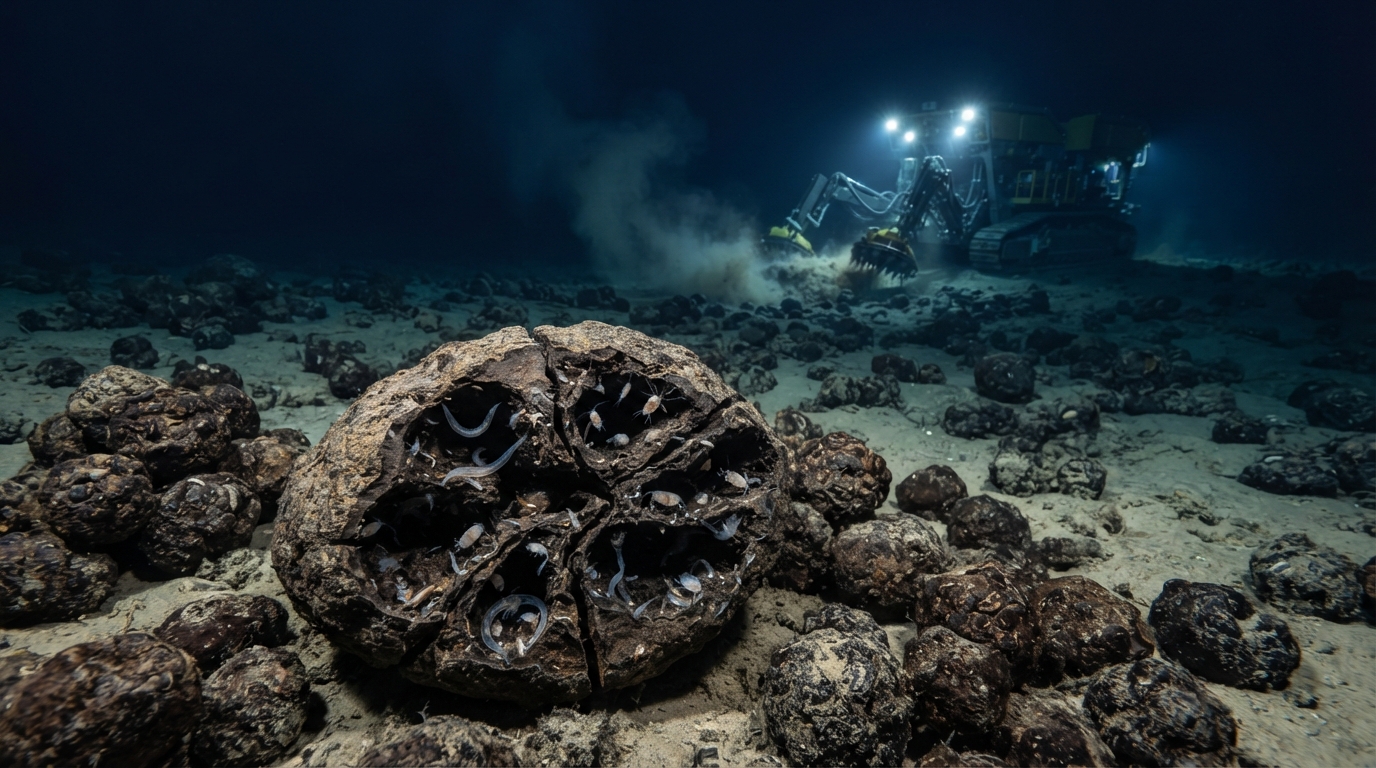
The glistenworms were collected at the Haima cold seep and a second seep in the South China Sea, and one specimen turned up by chance near a mud volcano off Japan, extending the species' known range. The animals live densely packed tens of centimeters below the sediment surface.
That mud is almost entirely without oxygen. According to China's national science and technology information center, microelectrode measurements showed the sediment was completely anoxic below about 3 millimeters, with high concentrations of hydrogen sulfide deeper down. Few animals can live in such conditions for long.
Most life on Earth ultimately runs on photosynthesis, which turns sunlight into food. At seeps and hydrothermal vents, certain bacteria do something similar with chemistry instead, pulling energy from compounds such as hydrogen sulfide or methane. Animals that host those microbes can thrive in total darkness, often in dense clusters around the leaking fluids.
The glistenworm itself is a newcomer to science. It was described only in 2024 and was named among the World Register of Marine Species' top 10 marine species discoveries of that year. Its class, the Caudofoveata, is one of the least studied groups of mollusks.
The research team includes first author Yunlong Li, deep-sea biologist Chong Chen, Jin Sun of the Ocean University of China, Pei-Yuan Qian of the Southern Marine Science and Engineering Guangdong Laboratory in Guangzhou and Jian-Wen Qiu of Hong Kong Baptist University.
Inside the 'Dragonball' Farms
The glistenworm has lost most of its gut. In its place is an enlarged, intricately folded digestive gland packed with specialized cells called bacteriocytes. Inside them sit the dracospheres, each about 12 micrometers across, several times thinner than a human hair.
Each sphere holds from several hundred to more than a thousand bacteria. DNA sequencing showed that every sphere contains just one symbiotic species, a sulfur-oxidizing bacterium. These microbes harvest energy from sulfur compounds seeping out of the seafloor and use it to build organic matter — essentially manufacturing food in the dark.
Researchers have long known that animals at hydrothermal vents and seeps, such as tube worms and some clams, host chemosynthetic bacteria. What is new — and what makes this find unusual — is a dedicated structure for doing it. The team's earlier preprint states that "To date, no organelle dedicated to chemosynthesis has been identified."
Two Ideas About How It Works
The researchers propose two functions, both still hypotheses. The first is feeding. The glistenworm may periodically break down some sphere membranes, releasing bacteria into the cell where they are digested. Because no digestive sacs called lysosomes were found inside the spheres, digestion probably happens outside them.
The second idea involves oxygen. In mud where oxygen is almost absent, the layered membranes may control how much oxygen reaches the bacteria. That could keep the microbes from consuming the trace oxygen the host needs, a strategy the authors compare to oxygen-protection tricks used by some nitrogen-fixing microbes and in termite guts. Their genomic and spatial gene-activity data support this view.
The authors also connect the discovery to tiny sediment animals already known to carry hydrogenosomes, energy-producing structures adapted to low oxygen. They suggest larger animals can evolve comparable solutions.
Proven Findings and Open Questions
This is an anatomical and genomic study. The team used microscopy, imaging of tissue in three dimensions, gene sequencing, and maps of gene activity, but it could not experiment on living animals. The authors write that their hypothesis "requires physiological validation," ScienceAlert reports, because no live specimens were available.
That means the study shows where the bacteria live and what genes they use, but it does not yet prove how the host feeds on them or controls oxygen. Calling the dracosphere an organelle is the authors' interpretation of a host-built compartment, and other biologists may debate the label. The work was first posted as a non-peer-reviewed preprint in January 2025 before its journal publication.
The discovery has no direct effect on households, but it adds to the case for studying deep-sea habitats before they are disturbed. Cold seeps hold species found nowhere else, many of them barely described, and scientists still know little about the animal group these glistenworms belong to.
There is also a sampling caveat. The specimens came from a small number of seep sites, so scientists do not yet know whether every population of the species, or any related glistenworm, carries the same structures.
The next step is to keep the animals alive long enough to measure oxygen use, feeding and bacterial growth directly. For now, the dragonball glistenworm stands as a well-documented example of an animal that farms its food inside its own cells, with key questions still to answer.
What Readers Want to Know
What is the 'dragonball' structure? A sphere about 12 micrometers wide, wrapped in more than 20 membrane layers, that holds hundreds of sulfur-oxidizing bacteria inside the cells of a deep-sea mollusk.
Which animal has it? Chaetoderma shenloong, the divine dragon glistenworm, a worm-shaped, shell-less mollusk that lives buried in mud at methane seeps in the South China Sea and off Japan.
How does the animal eat without sunlight or a full gut? Its bacteria make food from chemical energy in sulfur compounds. Researchers think the host digests some of those bacteria for nutrition.
Why is this discovery considered new? Many deep-sea animals host chemosynthetic bacteria, but no animal had been shown to build a dedicated compartment for them until this study.
Has the explanation been confirmed? Not fully. The authors say their ideas about feeding and oxygen control still need experiments on living animals.
Where was the study published? In Nature Communications, following a preprint first posted on bioRxiv in January 2025.
© 2026 NatureWorldNews.com All rights reserved. Do not reproduce without permission.














 English (US) ·
 French (CA) ·