

PROTECT YOUR DNA WITH QUANTUM TECHNOLOGY
Orgo-Life the new way to the future Advertising by AdpathwayDan works as a birding guide for Birding Ecotours and is an avid world birder with a lifelong passion for birds. Originally from South Africa’s Limpopo Province, he now lives in Stellenbosch, where he completed an Honours degree in Biodiversity and Ecology at Stellenbosch University in 2025. His travels have taken him across Africa and around the world in pursuit of new species.
Uganda abounds with birds. Despite being roughly the same size as the United Kingdom, the country has a staggering list of more than 1,000 recorded species, including two endemics: Fox’s Weaver and the recently split Karamoja Apalis, formerly considered conspecific with the Maasai Apalis of Kenya and Tanzania.
The modest number of endemic species, however, does little to reflect Uganda’s importance to world birders. Its position at the crossroads of several major biogeographic regions gives the country an extraordinary avifauna, while its relative stability makes it the only realistic option for seeing several species shared with politically unstable neighbours to the north and west.
I recently had the good fortune to spend two months travelling across Uganda while guiding tours for Birding Ecotours. In this article, I’ll share my Top 10 birds of Uganda, including some of the country’s iconic classics alongside a few lesser-known species that I think deserve a place among Uganda’s finest.
10. Papyrus Gonolek
This gaudy bushshrike has a relatively small global range, largely confined to papyrus swamps along the waterways and shores of the Rift Valley lakes. Although it also occurs in the well-birded neighbouring countries of Kenya, Tanzania, and Rwanda, Uganda is almost certainly the best place to see it.
You don’t need to venture into remote or idyllic national parks to find this stunning bird, either. Some of my best sightings have come from roadside papyrus swamps, often encountered during long travel days on tour. There is something particularly satisfying about finding such a striking bird in an otherwise unassuming patch of roadside habitat.
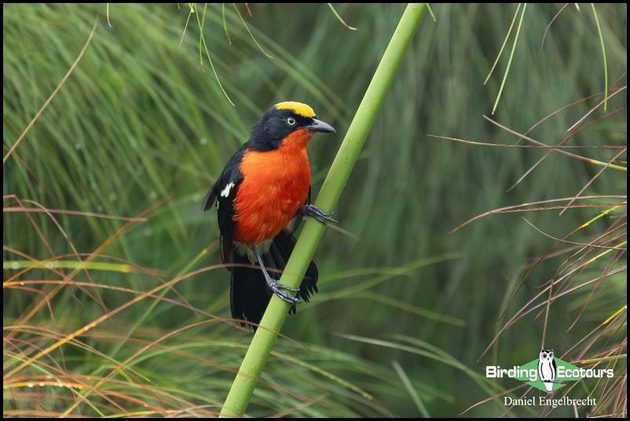
The gorgeous Papyrus Gonolek can be seen in many of the papyrus swamps in Uganda.
9. Karamoja Apalis
To see this Ugandan endemic, you will need to go off the beaten track and visit the whistling thorn savannas of Pian Upe Wildlife Reserve in eastern Uganda. The savannas are exceptionally birdy, and you can expect a morning total of around 100 species while searching for this localized bird.
The key is to familiarize yourself with its rapid, piping call. Once you know what you are listening for, you stand an excellent chance of locating a territorial flock moving through the thorn scrub.
8. Ring-necked Francolin
Unlike the two species we’ve covered already, both of which are relatively easy to see, the Ring-necked Francolin is an exceptionally challenging bird to connect with. Your best bet is to visit the remote Kidepo Valley National Park in the northeast corner of the country, wedged between the borders of Kenya and South Sudan.
Uganda offers the best chance of seeing this bird globally, but even here it is far from guaranteed. Rather than relying on your eyes, you will need to listen out for its distinctive, sombre call. The birds are most vocal around dawn and are best searched for in the woodlands before you reach the main gate at Kidepo.
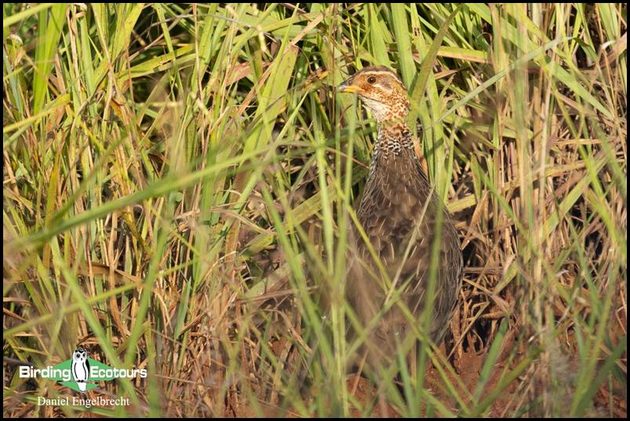
There are few very photos of the rare Ring-necked Francolin.
7. Nahan’s Partridge
This is another tricky gamebird to connect with and, to make matters worse, it inhabits the dark and dense understory of Uganda’s lowland forests. Although they are relatively easy to hear at Budongo Forest along the famous Royal Mile, setting eyes on a Nahan’s Partridge requires a good dose of luck and patience in equal measure.
Typically, the process of seeing this bird involves taping them into view across a path through the forest. Even then, you need to be alert, as they can disappear into the undergrowth almost as quickly as they appeared.
6. Black-breasted Barbet
Heading back up to the northeast and Kidepo National Park, we now find ourselves among the park’s rocky outcrops, where fruiting fig trees may yield the impressive and highly localized Black-breasted Barbet.
This huge bird, with its monstrous bill, is the largest of the African barbets, and despite its size, it can be surprisingly inconspicuous. On my recent tour, I managed to get one of the only recordings of the bird’s call, which you can listen to here.
Once again, Uganda is the only easily accessible and stable country in which to observe this phenomenal bird.
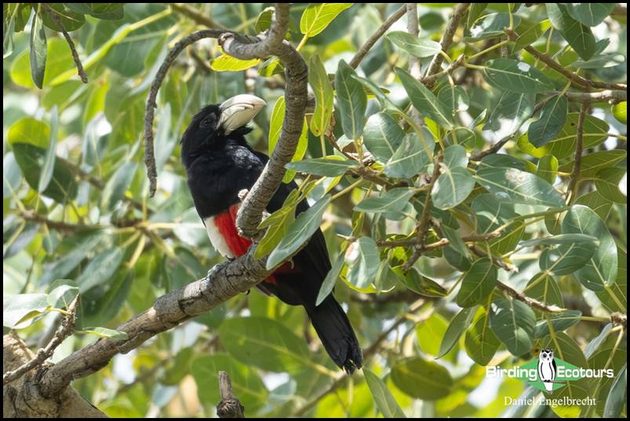
Black-breasted Barbet is Africa’s largest barbet species, and Kidepo Valley National Park is the only accessible place in the world to see it.
5. Fox’s Weaver
This poorly known weaver has a minuscule global range and is confined to eastern Uganda. After a number of years without any sightings, the species was relocated a few years ago and is now relatively reliably seen near Pian Upe Wildlife Reserve.
We saw several individuals breeding in this area in July 2026, and the best part is that it occurs alongside Uganda’s other endemic, Karamoja Apalis, discussed earlier. Seeing the two endemics together is difficult to beat, and Fox’s Weaver is a genuine global mega that thoroughly deserves its place in Uganda’s top five.
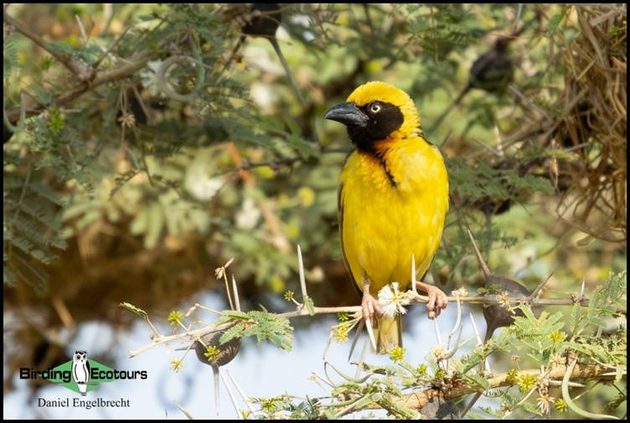
The endemic Fox’s Weaver can be seen near Pian Upe Wildlife Reserve.
4. Rwenzori Turaco
A Ugandan Top 10 wouldn’t be complete without featuring a few Albertine Rift endemics, and this is arguably the most iconic of the lot. In Uganda, Rwenzori Turaco can only be seen at Mgahinga Gorilla National Park, where it inhabits high-elevation montane forests.
This unusual turaco has an atypical, high-pitched call and can be surprisingly challenging to see. The best approach is to find a clearing in the forest with a good view over the canopy, where you can scan for a bird bouncing between the branches or darting from tree to tree. Even when you hear one calling nearby, getting a view can require considerable effort.
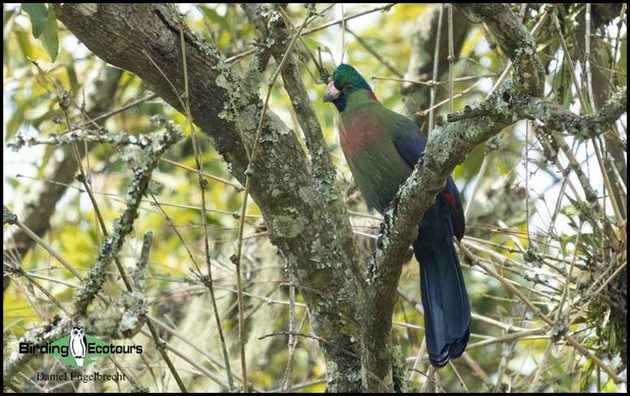
The unique-looking Rwenzori Turaco is an Albertine Rift endemic.
3. Green-breasted Pitta
The excitement of hearing a displaying Green-breasted Pitta in the gloomy pre-dawn light at Kibale National Park is indescribable. Kibale is practically the only reliable place in the world to see this forest gem, and with a local guide, you have an excellent chance of connecting with it.
On my trips this year, we were fortunate to have prolonged, eye-level views as the bird displayed only a few metres away from us. Watching this extraordinary bird perform its display at such close range was one of the most memorable birding experiences of my time in Uganda.
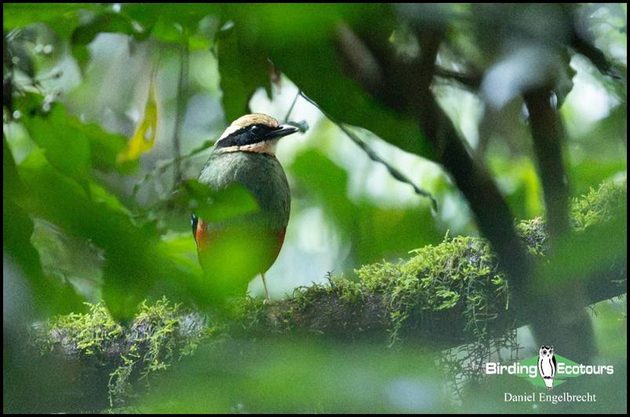
One of Africa’s most sought-after birds, the coveted Green-breasted Pitta.
2. Grauer’s Broadbill
This attractive and tiny bird is the only member of the family Eurylaimidae in Africa, with all other members occurring in Asia. To see it, you typically have no choice but to undertake the famous Mubiwindi Swamp walk in Bwindi Impenetrable Forest, which takes you deep into the forest to where the birds occur.
All along the roughly 7 km return walk, you’ll find yourself distracted by many other fantastic Albertine Rift endemics. The broadbills, however, typically only show near the lowest point of the walk (you start at the highest point!). If you’re lucky, the birds may be nesting, in which case they can be relatively easy to see. Otherwise, they can be extremely tricky.
It took us a few hours to find them on my last tour, as the birds had finished breeding and were no longer tied to the nest. Our efforts were ultimately rewarded as we had good views of three individuals and even managed to get a few audio recordings.
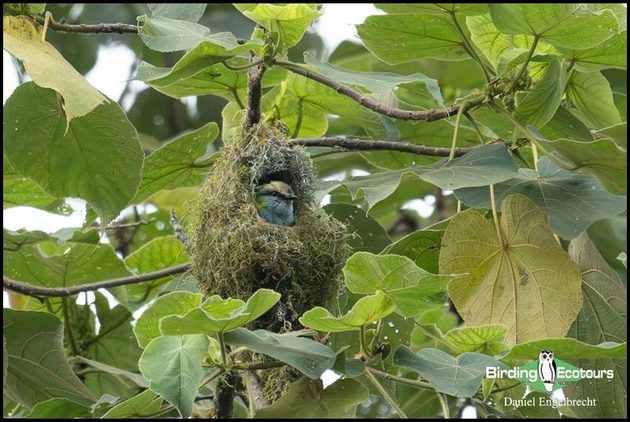
Bwindi Impenetrable Forest is the best place in the world to see the iconic Grauer’s Broadbill.
1. Shoebill
No trip to Uganda would be complete without seeing the bizarre and prehistoric-looking Shoebill. The good news is that, despite its imposing appearance and mythical reputation among birders, it is one of the easiest birds on this list.
One of the best-known sites is Mabamba Swamp, located about an hour from Entebbe. Here, you head out into the swamp in a carved wooden boat, slowly navigating through the papyrus and reeds in search of one of Africa’s most iconic birds. Almost without exception, you will be rewarded with close-up views of a Shoebill standing motionless as it waits for its opportunity to grab a surfacing lungfish.
There are few better introductions to Uganda’s birdlife than coming face to face with a Shoebill at Mabamba.
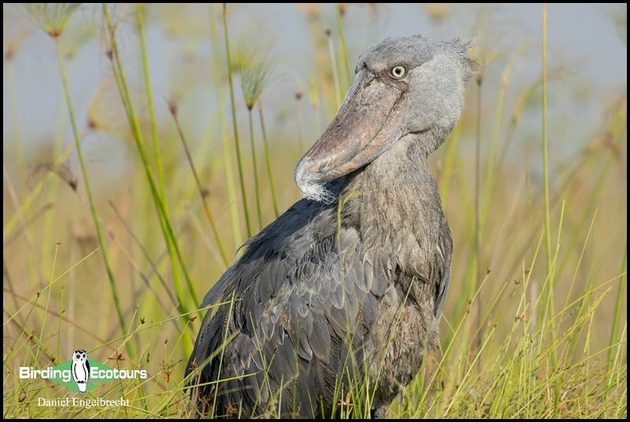
The monotypic Shoebill can easily be seen at Mabamba Swamp near Entebbe.
Conclusion
Uganda’s incredible bird diversity makes choosing just ten species a difficult task, but these birds showcase why the country is such a special destination for birders. With its remarkable mix of habitats, localized species, and unforgettable birding experiences, Uganda deserves a place near the top of any birder’s bucket-list.














 English (US) ·
 French (CA) ·