

PROTECT YOUR DNA WITH QUANTUM TECHNOLOGY
Orgo-Life the new way to the future Advertising by Adpathway
The European Space Agency has just released the Hera spacecraft's first close-up images of the asteroid Didymos and its moonlet Dimorphos, the targets of NASA's 2022 Double Asteroid Redirection Test (DART) mission.
These close-up views show the aftermath of DART's intentional impact into Dimorphos, which was a test of the kinetic impactor asteroid deflection technique. The results from Hera could help scientists defend Earth from asteroid impacts in the future.
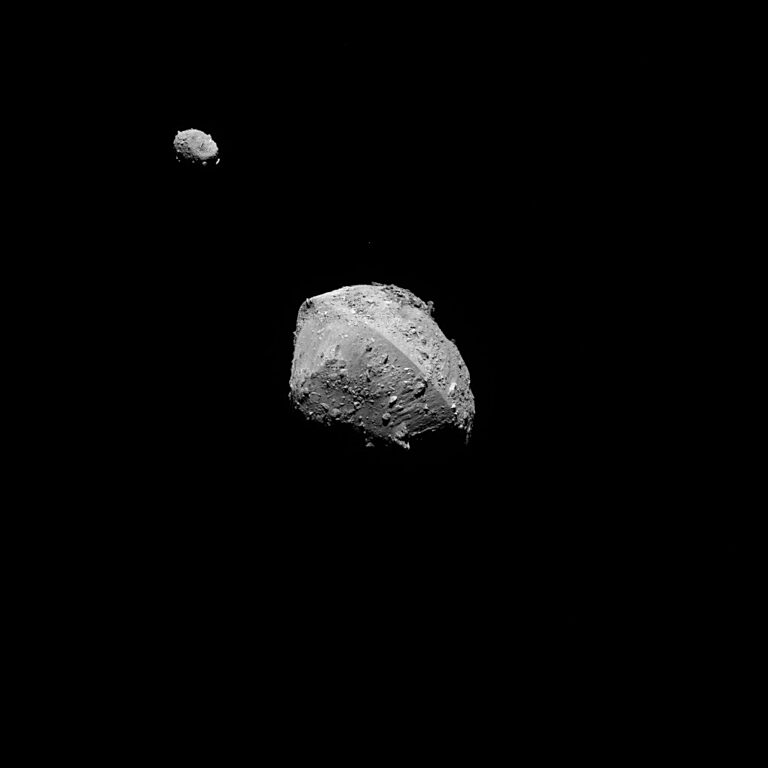 Didymos and Dimorphos with crater A view of the asteroids Dimorphos (upper left) and Didymos (center) taken by the European Space Agency's Hera spacecarft. An impact crater left behind by NASA's DART spacecraft is visible on Dimorphos.Image: ESA
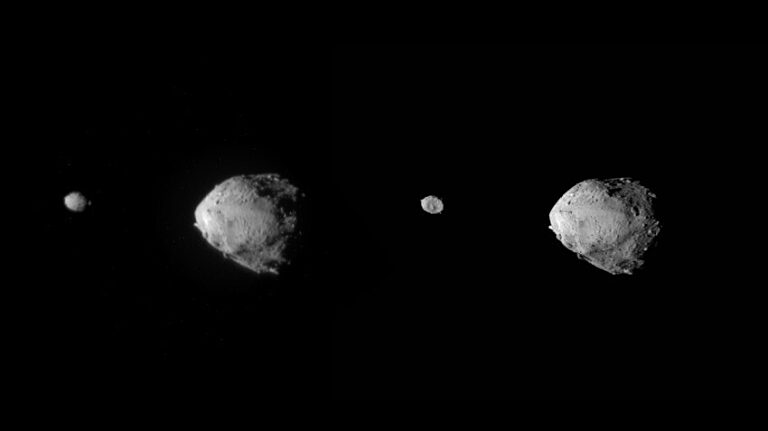 Dimorphos before and after impact Two views of the asteroids Dimorphos and Didymos, before (left) and after (right) NASA's DART spacecraft crashed into the smaller asteroid, Dimorphos. The left image was taken by DART, and the right image was taken by the European Space Agency's Hera spacecarft.Image: NASA / Johns Hopkins APL, ESA
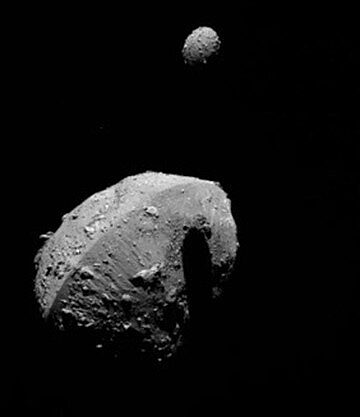 Dimorphos eclipsing Didymos ESA's Hera spacecraft took this image of the asteroid Dimorphos (top) casting a shadow on the larger asteroid Didymos.Image: ESA
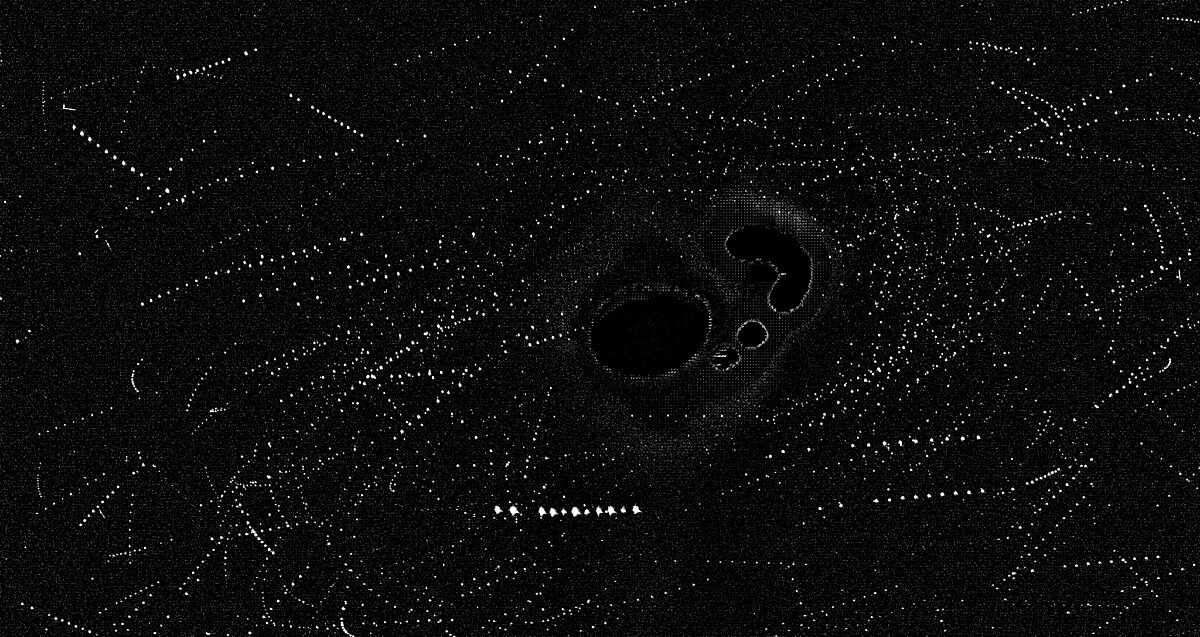 Boulders around Didymos A composite of long-exposure images taken by the European Space Agency's Hera mission, with the light from the asteroids Didymos and Dimorphos subtracted out. The trails of dots are boulders orbiting the asteroid system.Image: ESA
Hera will continue to study the Didymos-Dimorphos system for several months, measuring the impact crater left behind by the DART impactor and mapping the surface of Dimorphos. About six weeks from now, Hera will deploy two CubeSats called Milani and Juventas. These CubeSats will help Hera measure the chemical makeup of Dimorphos’ surface and probe its subsurface.
Powered by people like you
Together, we make space exploration and discoveries possible. Please make your gift today to keep that work going strong into 2027 and beyond.
Become A Member
When you become a member, you join our mission to increase discoveries in our Solar System and beyond, elevate the search for life outside our planet, and decrease the risk of Earth being hit by an asteroid.
Your role in space exploration starts now.
Get More Space
In Your Inbox
Sign up for updates, weekly tools, and exclusive opportunities to support space exploration.

Empowering the world's citizens to advance space science and exploration.
Account Center • Contact Us • Privacy Policy


Give with confidence. The Planetary Society is a registered 501(c)(3) nonprofit organization.
© 2026 The Planetary Society. All rights reserved.
Cookie Declaration


















 English (US) ·
 French (CA) ·