

 4 hours ago
2
PROTECT YOUR DNA WITH QUANTUM TECHNOLOGY
Orgo-Life the new way to the future Advertising by Adpathway10 November 2026
Last week while I was learning about the effects of artificial night light on insects, I encountered sobering news about its effects on birds: For two backyard bird species, more light pollution is linked to lower survival.
Published in July 2023, the study explains:
We used 20 years of band-resight data collected as a part of the Neighborhood Nestwatch Program (NN) … at 242 sites in greater Washington, D.C. We estimated apparent survival and documented species-specific relationships with light and noise.
Gray Catbird (Dumetella carolinensis) and [Northern] House Wren (Troglodytes aedon) survival decreased and American Robin (Turdus migratorius) survival increased with greater amounts of anthropogenic light.
Anthropogenic noise had no relationship with apparent survival for any of the seven species.
— Springer.com: Using citizen science data to investigate annual survival rates of resident birds in relation to noise and light pollutionTo see the effect of noise and light pollution researchers overlaid banding area maps with maps of noise pollution, light pollution, and paved surfaces. Then they examined the longevity of seven species in those areas. Only three were affected by light; none by noise.
- American robin (Turdus migratorius) (longer life)
- Carolina chickadee(Poecile carolinensis)
- Carolina wren (Thryothorus ludovicianus)
- gray catbird (Dumetella carolinensis) (shorter life)
- Northern house wren (Troglodytes aedon) (shorter life)
- northern cardinal (Cardinalis cardinalis)
- song sparrow (Melospiza melodia)
American robins were winners in this study. They live longer in the presence of artificial light at night, perhaps because “robins will start singing earlier in the morning in areas with more light pollution, potentially increasing the amount of time they have for finding mates or foraging.” — NC State News.
I’ve noticed that in March in Pittsburgh the robins sing in the dark near the streetlights. They get up extra early to do this.
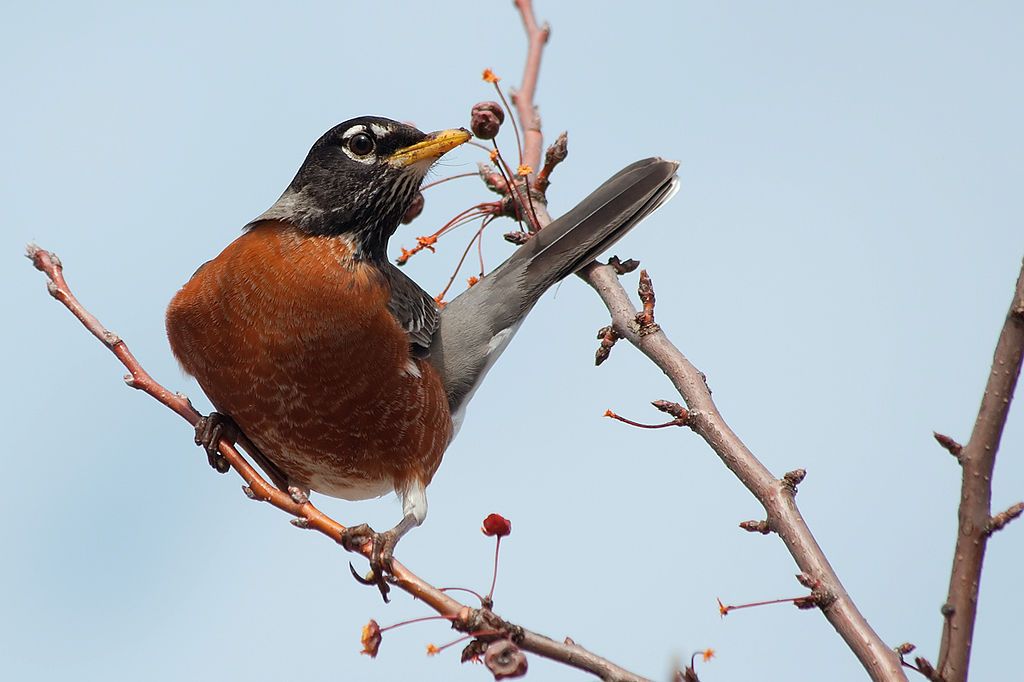 American robin (photo from Wikimedia)
Unfortunately gray catbirds and northern house wrens who breed in light polluted areas have lower survival rates, but we don’t know why yet.
However there are things we can do. If your backyard hosts nesting gray catbirds and house wrens, it may be more amendable when you lower light levels for them. (The robins might not like this.) Be sure to see Cornell Lab’s 7 things you can do to make your yard safer for birds.
Find out more about this study at:














 English (US) ·
 French (CA) ·