

 4 hours ago
6
PROTECT YOUR DNA WITH QUANTUM TECHNOLOGY
Orgo-Life the new way to the future Advertising by AdpathwayThe end is in sight. If all goes as planned, countries as diverse as wealthy petrostates erecting new oil rigs and low-lying islands threatened by rising seas will reach an agreement tomorrow in Antalya, bringing the 31st UN climate summit to a close (though, as usual, the talks are likely to overrun).
But tensions – much like our global temperatures – are running high. A draft text that satisfies all the competing interests is a long way off, and negotiators are expected to argue into the night and then the weekend. On the table are the electrification of the global economy, the transition away from fossil fuels, and the response to the looming overshoot of the 1.5C (2.7F) temperature target. Deepening the divide are long-running disputes over who should pay what, and emerging fights over the fairness of the transition and assumptions in the underlying science.
I’ve been following the contentious climate talks from afar every day for our liveblog, as my tireless colleagues on the ground have raced from interview to interview. The three big issues frustrating diplomats help the rest of us make sense of how well humanity is doing at keeping the planet habitable.
Here’s what stands out, and what’s at stake in these final days. But first, the headlines.
Essential reads
-
‘Huge experiment in biogeography’: US offshore windfarms are creating artificial reefs
-
‘When it roars, we roar back’: the man who faces Bengal tigers armed only with a stick
In focus
In just a few years, global heating is set to surpass that dangerous 1.5C (2.7F) threshold world leaders had promised to pursue for the end of the century. Temperatures could still be brought back down a touch after reaching net zero emissions, but the Paris climate target only stays in play if overshoot is limited – and brief.
In what struck me as the most powerful speech of the two-day leaders’ summit last week, Hilda Heine, president of the embattled Marshall Islands, told her counterparts that it was time to “wake up” to what crossing that threshold would really mean. “Our response to the threat of overshoot must be overwhelming, or the world we know is over.”
Many countries can reasonably claim to be on the frontlines of the climate crisis but small islands face the darkest future from crossing the 1.5C target, as even a brief period of extra heat pushes sea levels higher for the centuries that follow. A couple of weeks ago, a UN report argued that Earth’s icy regions face such dangerous melting that temperature rise should be brought back below 1C, decrying the “persistent myth” that peak heat of 2C or 3C could be manageable or preferable to rapid emissions cuts.
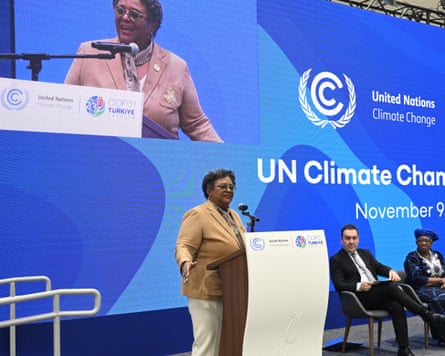
“Overshoot is not a new target,” said Mia Mottley, the prime minister of Barbados, as she called on fellow heads of state and government to cut emissions faster. “It is a debt, a debt of heat, borrowed against our children’s future. And it must be repaid.”
The obvious answer, which scientists (and fossil fuel companies) have known for decades, is to quickly stop burning coal, oil and gas. But while “fossil fuels” made it into the text of the draft deal published on Monday – words that first featured in the final outcome at the 26th iteration of these yearly climate talks – observers fear the Turkish and Australian co-hosts have not done the diplomatic groundwork for such wording to survive.
The world is “being held hostage by the petroleum mafia” and seems unable to break free, Panama’s environment minister, Juan Carlos Navarro, warned on Wednesday. “We are in love with our kidnappers,” he said. “We love the petroleum guys. We can’t live without them, and they are so smart they have convinced us that they are doing this for our own good.”
The bright spark, if there is one, is that the push to electrify the global economy is gaining momentum. The pledge to source 35% of the world’s final energy consumption from electricity by 2035 is understood to have the backing of scores of countries, though most of them are yet to formally sign on.
after newsletter promotion
Electrification is a threat to the fossil fuel industry – swapping a gas boiler for a heat pump, or a combustion engine car for an electric vehicle, will inevitably mean less oil and gas gets burned. But it is an easier sell than measures that directly punish polluters. Indeed, even many climate-denying governments have built solar panels and batteries with gusto, while deriding “woke” green climate action.
However, how clean that electricity should be is still up for debate. Though the raw efficiency gains from electrification mean that even machines powered by a dirty power grid would be better for the planet than the status quo, campaigners fear not being more specific will leave the door open to new gas-fired power plants.
In just one of many examples of the murky world of climate negotiations, Wopke Hoekstra, the EU’s climate commissioner, expressed solid support for the pledge on Monday – “The more, the better. The quicker, the better. The cleaner, the better.” – but indicated that Europe was open to flexibility on the last point “if, to some degree, a bit of pragmatism is needed to bring others into the tent”.
The climate crisis can often feel hopeless but change – messy, sporadic, insufficient – is happening all around us. Supporting the Guardian’s rigorous journalism that holds polluters to account is one way you can contribute – please consider doing so here.
Read more from Cop31:
World ‘held hostage by oil mafia’, says Panama minister at Cop 31
IPCC report delay will threaten global effort to tackle climate crisis, says top scientist
Cop31 as it happened: rich world offering ‘crumbs’ to help poor countries adapt to climate breakdown, campaigners say















 English (US) ·
 French (CA) ·