

 8 months ago
229
8 months ago
229
PROTECT YOUR DNA WITH QUANTUM TECHNOLOGY
Orgo-Life the new way to the future Advertising by AdpathwayJames Webb Space Telescope observations suggest the planet might have an atmosphere — but more data are needed to rule out a bare rock scenario.
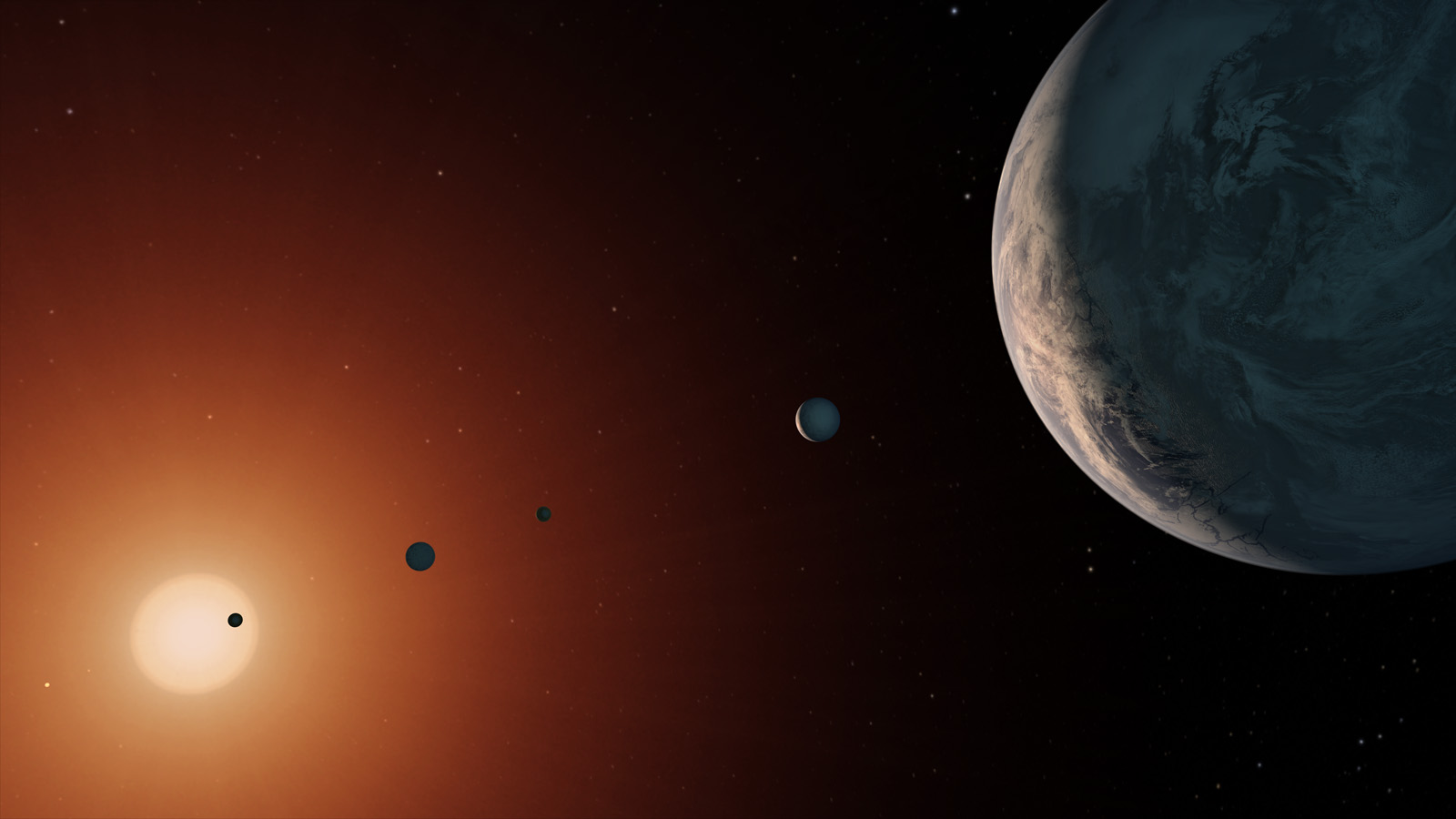 This illustration shows what the TRAPPIST-1 system might look like from a vantage point near planet TRAPPIST-1f (at right). The inner planets are likely bare rocks; whether the outermost worlds host atmospheres is still up in the air.
NASA / JPL-Caltech
The TRAPPIST-1 system is iconic among exoplanet hunters, hosting no less than seven Earth-size planets around a tiny, red dwarf star only 40 light years away. Four of these planets reside in the star’s habitable zone, where liquid water could exist on the surface. But for that liquid water to exist, the planets must have one crucial ingredient: an atmosphere.
Astronomers have been using the James Webb Space Telescope (JWST) to observe this system, and they’ve ruled out the possibility of an atmosphere on the three innermost worlds: TRAPPIST-1b, TRAPPIST-1c, and the habitable-zone planet TRAPPIST-1d. Now, they’ve turned their sights to TRAPPIST-1e, an Earth-size world that orbits its small star every six days.
But the findings, published across a series of three papers in Astrophysical Journal Letters, aren’t conclusive. The planet might have a nitrogen-rich atmosphere with traces of methane, but it could instead have no atmosphere at all, or an atmosphere obscured by clouds. Stellar flares and spots from the active host star contaminate the data, making it difficult for the team to distinguish between different scenarios.
Know Thy Star, Know Thy Planet
“The TRAPPIST-1 system is a goldmine,” says Ignas Snellen (Leiden Observatory), who was not involved in the studies. The star is small (about a tenth the size of the Sun), close to Earth, and its planets all happen to transit — all of which make these worlds easier to observe. What’s more, the habitable-zone planets are closer-in to their star, so we can watch their transits more often.
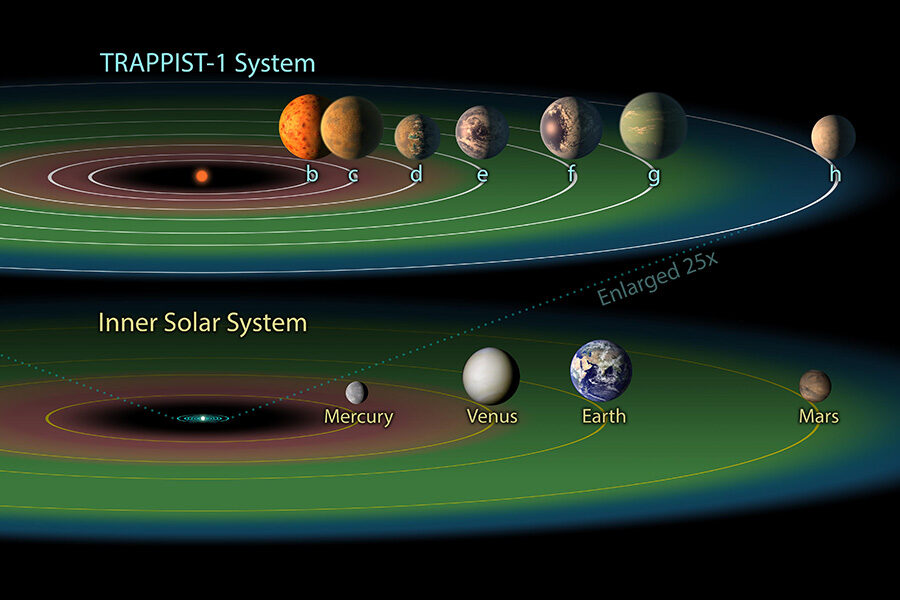 Three planets in the TRAPPIST-1 system — TRAPPIST-1e, f and g — orbit in the star's so-called "habitable zone," a band (shown here in green) in which liquid water might exist on a rocky surface — if there's an atmosphere.
 NASA / JPL-Caltech
Using JWST’s Near-Infrared Spectrograph, the team observed four transmission spectra of TRAPPIST-1e, capturing the star’s light as it passed through a sliver of atmosphere while the planet crossed in front of its star in June, July, and October 2023. This technique looks for molecules in a planet’s atmosphere by their absorption of the star’s light at different wavelengths.
But TRAPPIST-1’s stellar activity poses a major challenge to habitability. The star currently radiates intense UV and X-ray flares, and it was even more active in the first billion years, including when planets were still forming. While the energy could “kickstart life,” it also might’ve stripped its planets bare, says Ana Glidden (MIT), who led one of the TRAPPIST-1e studies.
The little star’s flurry of activity also makes it more difficult to study its planets. The team found in a related study that the star’s emissions contaminated the spectra in various ways at different times.
Based on the spectra, the team was able to rule out a puffy hydrogen-dominated atmosphere. The astronomers found that the data best match an atmosphere with heavier elements, more like Earth’s. But the spectrum was also consistent with a bare rock or an atmosphere obscured entirely by clouds.
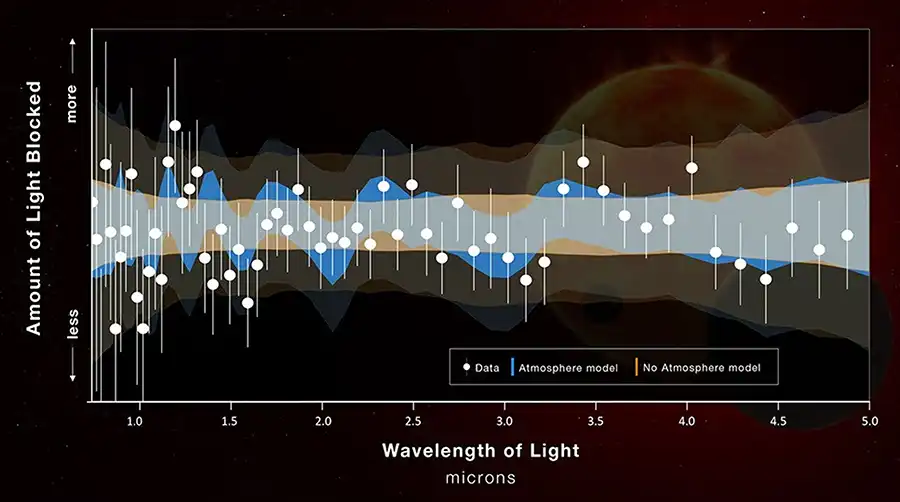 This transmission spectrum graph compares data collected by the NIRSpec (Near-Infrared Spectrograph) instrument on NASA’s James Webb Space Telescope with computer models of exoplanet TRAPPIST-1 e with (blue) and without (orange) an atmosphere.
NASA / ESA / CSA / STScI / Joseph Olmsted (STScI)
Snellen, while congratulating the team on “fantastic work,” contemplates the future of the technique. “I do wonder whether we are hitting the end of the road for transmission spectroscopy in general,” he says. “The overwhelmingly large noise and systematic effects associated with the star could be too much for this task, but it is great that they are trying.”
The team thinks there’s still room for improvement, though. The astronomers knew that they would need more than four observations to unambiguously detect an atmosphere despite the stellar contamination — more transits increase the confidence that features are really there and not due to noise. “Fortunately, more observations and new techniques are both being implemented for this target,” says team member Sukrit Ranjan (University of Arizona), “and I personally am hopeful for it.”
Hints of a Warm, Titan-like Atmosphere
If TRAPPIST-1e does have an atmosphere, the team found that it would most likely be nitrogen-dominated, like on Earth. Their results also favor the presence of methane, similar to Saturn’s moon Titan.
Since TRAPPIST-1e is tidally locked, with the same side always facing its star, it could be a frozen ball of ice. Ice on the star-facing side could melt enough to form a liquid ocean, making it one of those peculiar “eyeball” planets that sound straight out of science fiction. In fact, a previous study found that TRAPPIST-1e might have liquid water at its “pupil” regardless of atmospheric composition.
But to melt ice more globally requires greenhouse gases such as carbon dioxide or methane. The observations even allow for this scenario, though it’s not as good a match to the data. Out of all the atmospheric possibilities, the best-match scenario is the so-called “warm exo-Titan,” dubbed as such because it resides much closer to its star than Titan is to our Sun.
Yet in a third study, Ranjan and colleagues found that chemical reactions on such a warm world ought to rapidly convert methane to carbon dioxide and carbon monoxide. “We predict such planets, even if made up of the same stuff as Titan, would not look like Titan,” Ranjan says. “And therefore, if the data at face value show that a warm exo-Titan exists, it merits a hard second look to make sure the conclusion is robust.”
The team has already scheduled 15 additional JWST observations of the planet’s transits alongside the airless innermost planet, TRAPPIST-1b. Since the transmission spectrum of airless TRAPPIST-1b would only show stellar noise, observing the transits back-to-back would allow the astronomers to better account for stellar activity in TRAPPIST-1e’s spectrum.
“We are pushing the limits of JWST to try and detect an atmosphere of a temperate, terrestrial planet,” Glidden says. The upcoming observations could, for the first time in history, confirm an atmosphere on a terrestrial planet beyond the solar system. “Finding an atmosphere on such a world would be a major advancement in the search for life.”














 English (US) ·
  French (CA) ·