

PROTECT YOUR DNA WITH QUANTUM TECHNOLOGY
Orgo-Life the new way to the future Advertising by AdpathwayTens of thousands of years ago, a long-legged cat nicknamed the “American cheetah” prowled North America. But an analysis of the cat family tree reveals this cheetah’s closest living relatives are pumas, researchers report September 4 in Current Biology.
That relationship matters because the nickname has long suggested a particular kind of animal: a specialized, high-speed predator like the African cheetah built to chase fleet-footed prey such as American pronghorn, which can sprint up to nearly 90 kilometers per hour. But a growing body of evidence hints that the American cheetah (Miracinonyx trumani) may be more closely related to modern-day pumas. Pumas are far more flexible hunters, taking prey that range from large, hoofed animals like deer and elk to much smaller rodents and raccoons.
Now, fossils from Canada’s Yukon Territory suggest M. trumani may have been more flexible, too. The extinct Pleistocene predator inhabited North American grasslands from roughly 2.5 million to 16,000 years ago, and its fossils have sometimes been found alongside presumed prey. But the newly analyzed Yukon remains expand the cat’s known range further to the north — and chemical clues preserved in the fossils suggest those northern animals may have eaten aquatic animals.
“Calling it the American cheetah implies a specific behavior and ecology, which isn’t necessarily appropriate for this species,” says Molly Cassatt-Johnstone, a molecular ecologist at the University of California, Santa Cruz.
She and colleagues didn’t set out to uncover the American cheetah’s true family tree. The original goal was to use ancient genetic material to verify the identity of three roughly 31,000-year-old fossils from the Yukon. Because the fossils were so far north, researchers had tentatively identified the fossils as pumas.
“It wasn’t until we were able to generate the genetic data that we were able to identify them as American cheetahs,” Cassatt-Johnstone says. “Then, that led to this whole discovery avalanche.”
A broad range
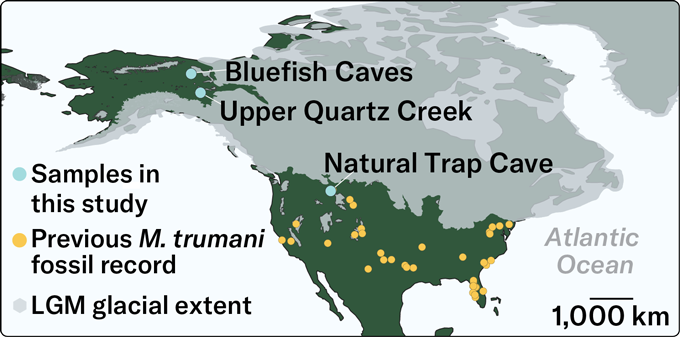
Miracinonyx trumani, the “American cheetah” lived across a broad swath of North America. The previous fossil record spanned from Florida to the northern plains. Three new specimens from Bluefish Caves and Upper Quartz Creek in Yukon Territory expanded the cheetah’s known range into Canada. Ancient DNA from those specimens, plus another from Natural Trap Cave in Wyoming, revealed M. trumani’s closest modern relative is the puma.
 M. Cassatt-Johnstone et al./Current Biology 2026M. Cassatt-Johnstone et al./Current Biology 2026
Ancient DNA from the Yukon specimens, plus DNA from another M. trumani fossil unearthed in Wyoming, confirmed the species’s closest relative is pumas. The two species last shared a common ancestor around 2.6 million years ago. M. trumani and cheetahs, on the other hand, split roughly 4.7 million years ago.
Because the animals lived so far north, most likely without pronghorn, the team wanted to know what the cats ate. The team analyzed a heavy form of nitrogen to determine where M. trumani fell in the food chain. Predators that eat other animals have more of the heavy form of nitrogen relative to the lighter form, while prey that eat mostly plants have less.
M. trumani specimens from Wyoming had heavy nitrogen levels that suggested it was a terrestrial carnivore that feasted on herbivores. Yukon M. trumani, however,may have eaten almost exclusively fish. The amount of heavy nitrogen in their fossils were comparable to levels found in marine carnivores such as orcas, which sit atop a long food chain of fish eating other fish.
One of the Yukon fossils was even found in a cave that also harbors many Pleistocene fish fossils, Cassatt-Johnstone says. “It’s clear that the resource was around and that they could have been exploiting it, which is awesome.”
It’s unknown whether northern M. trumani went fishing themselves or if they scavenged carcasses along riverbanks. Chasing down large prey can be dangerous for carnivores, and switching to another source of food can help lessen the risk of crushed skulls or failed hunts.
“If they’re able to exploit a prey resource that is abundant and doesn’t cause them significant injury, that’s a win-win,” says Larisa DeSantis, a paleoecologist at Vanderbilt University in Nashville who was not involved with the work. “It’s really cool to see that sort of adaptability in the American cheetah.”
Scrutinizing more specimens across its range, including south of Wyoming, could reveal just how adaptable the “American cheetah” truly was and how much its familiar nickname has obscured about the way this extinct cat lived.











 English (US) ·
  French (CA) ·