

 5 months ago
116
5 months ago
116
PROTECT YOUR DNA WITH QUANTUM TECHNOLOGY
Orgo-Life the new way to the future Advertising by AdpathwayIn the science-fiction novel and movie “Project Hail Mary,” the story revolves around the rigors of an astronaut working and surviving during a yearslong mission, the power of deep-space communications, the search for life beyond Earth, and nearby star systems that actually exist — Tau Ceti and 40 Epsilon A.
Let NASA shed some light — explore the resources below to learn the science facts fueling the science fiction.
what is answer, question?
Images at top:
A Glowing Green Planet, Teeming With Life
What might look like a pair of spacecraft orbiting a pale green exoplanet (as "Adrian" is described) is actually a photo of the International Space Station above Earth in October 2024. Severe geomagnetic storms created not only the more common shimmering green northern lights, but also very rare bright-red auroras in the atmosphere. Credit: NASA astronaut Don Pettit
Venus Gets Between Earth and the Sun
The 2012 Transit of Venus — the spectacle of Venus as it passes across the face of the Sun — is captured in this multiple-exposure, ultra-high-definition view by the Solar Dynamics Observatory spacecraft. The rarest predictable solar event, the next Venus transit won’t happen until 2117. Credit: NASA/Goddard Space Flight Center/SDO
No Rocky Exoplanet
Rocky exoplanet 40 Eridani A b might not exist, but this near-infrared image shows the confirmed exoplanet 51 Eridani b, about 96 light-years from Earth. Captured in 2014 by the Gemini Planet Imager, this view masks the star at center, 51 Eridani, so its glare doesn't obscure the Jupiter-sized planet, 51 Eridani b, which orbits 11 billion miles from its star, a little farther out than Saturn's orbit in our solar system.
Credit: Gemini Observatory, NSF’s NOIRLab, NSF, AURA, Julien Rameau (University of Montreal), Christian Marois (NRC Herzberg)
Artemis and Human Spaceflight
NASA is returning astronauts to deep space for the first time in 50+ years, when the upcoming Artemis II mission carries four crew members beyond the Moon and back — venturing farther from Earth than humans have ever traveled. Artemis III and IV will follow, orbiting Earth and then returning astronauts to the surface of the Moon. Each mission builds on the ones before it, extending further, for ever-longer periods of time, expanding human exploration from the Moon, to Mars, and beyond.
But space travel is hard on humans— especially extended missions — so NASA has long studied the impacts of spaceflight on astronauts, including the effects of isolation and the ways that microgravity changes the body, as well as ways to develop food that's appetizing as well as nutritious.
Artemis Missions
Sending astronauts on increasingly difficult missions to explore more of the Moon for scientific discovery, economic benefits, and to build on our foundation for the first crewed missions to Mars.
Extended Stays in Space
NASA’s Human Research Program pursues the best methods and technologies to support safe, productive human space travel.
International Space Station
For 25 years, it's been the extraterrestrial home and science lab for rotating crews of astronauts, now totaling nearly 300 individuals, working and living for hundreds of days at a time.
In It For the Long Haul
-
Long-Duration Spaceflights
In "Project Hail Mary," a character mentions that his spacecraft will "await instructions from the Deep Space Network," and that they could be as far away as the orbit of Saturn. In real life, the DSN routinely sends and receives messages to spacecraft at the Moon, the outer planets, and even the farthest spacecraft in history, Voyager 1, which is currently about 16 billion miles beyond Saturn (26 billion kilometers).
deep dish
Long-Distance Call and Response: Watch How the DSN Works
When scientists and engineers want to send commands to a spacecraft in deep space, they turn to the Deep Space Network, NASA’s array of giant radio antennas around the globe, making it possible to communicate with spacecraft at the Moon and far beyond.
Learn More About the Deep Space Networkthe search for life
Astrobiology
Are we alone? Is there life anywhere else in the universe? NASA has been striving to answer these big questions — maybe the biggest — since its first exobiology research in 1959. Ever since, the agency has been investigating life on many levels: how it began, how it evolved here on Earth, and where it might exist elsewhere.
Learn more about NASA's search for life in the cosmos- The Searchers: How Will NASA Look for Signs of Life Beyond Earth?
- Life on Other Planets: What is Life and What Does It Need?
- Searching for Signs of Intelligent Life: Technosignatures
Red Planet Rovers, Searching for Signs of Life
-
‘The closest we have ever come to discovering life on Mars.’
In the summer of 2024, NASA's Perseverance Mars rover investigated its “most puzzling, complex, and potentially important rock yet,” according to one mission scientist. It showed signs of past water, organic material, and clues suggesting chemical reactions by microbial life. In September 2025, after a rigorous, yearlong peer-review to scrutinize the Mars 2020 team findings, the journal Nature published the validated results: Perseverance’s "Sapphire Canyon" sample from the rock nicknamed “Cheyava Falls” contains potential biosignatures — clues that suggest past life may have been present, but that require more data or further study before any conclusions about the absence or presence of life.
Read ‘NASA Says Mars Rover Discovered Potential Biosignature’
The Sun
The star in our backyard; it may appear like an unchanging source of light and heat in the sky. But the Sun is a dynamic star, constantly changing and sending energy out into space — energy necessary for life on Earth. And it's been doing that for about 4.6 billion years, with another 5 billion or or so in its current state. Learn more about the Sun and how NASA studies it, including the first spacecraft ever to fly through its atmosphere and touch the only star we can study up close.
Venus
Venus is sometimes called Earth’s twin, because it’s our closest planetary neighbor and is similar in size and structure. But the similarities end pretty quickly. Venus has a surface temperature hotter than Mercury (which is much closer to the Sun), and its atmosphere is a heat-trapping blanket of carbon dioxide that creates air pressure nine times greater than on Earth, with sulfuric-acid clouds swirling at 200 mph.
Exoplanets — Other Stars, Other Worlds
Exoplanets are planets outside our solar system; for the most part they orbit other stars, the way that Earth, Venus, and the other planets in our solar system orbit the Sun. Scientists have confirmed more than 6,000 exoplanets in our galaxy, out of the billions that we believe exist. Learn more about some of the nearby star systems with newfound celebrity — Tau Ceti and 40 Eridani A.
Tau Ceti
Tau Ceti has long been a popular setting in science fiction, as one of the nearest Sun-like stars. Featured in works by Isaac Asimov, Arthur C. Clarke, Frank Herbert, Robert Heinlein, Ursula K. Le Guin, and Kim Stanley Robinson, the Tau Ceti system even serves as the setting for the 1968 Jane Fonda film, "Barbarella." In "Project Hail Mary" it's the origin of an apocalyptic plague, source of the Earth-saving solution, and perhaps even the ancestral home of one or more characters.
Tau Ceti e
Nicknamed “Adrian” in "Project Hail Mary," this exoplanet is one of four confirmed planets orbiting Tau Ceti. Scientists know it exists, but don't know its color, or whether it hosts any life — microbial, predatory, or otherwise.
40 Eridani A
Another popular star in science fiction, 40 Eridani A is home to the planet Vulcan in “Star Trek” and a life-supporting planet in "Dune." The star is actually part of a three-star system, with 40 Eridani B and C; it’s also called Keid (from the Arabic word for eggshells) or HD 26965.
The exoplanet 40 Eridani A b, which was falsely detected in 2018, inspired the exobiology in Andy Weir's novel “Project Hail Mary.” This involved an extremely high-pressure world where life evolved to “see” using echolocation, to minimize movement and energy expenditure.
40 Eridani A b
The exoplanet called Erid in “Project Hail Mary” — Rocky’s home world; it was thought to be a real exoplanet when discovered in 2018, but turned out to be a false positive. At the time, people liked to compare it to Vulcan from Star Trek, because that planet also orbited 40 Eridani A.
no erid, question?
Discovery Alert: Spock’s Home Planet Goes ‘Poof’
A planet thought to orbit the star 40 Eridani A — host to Mr. Spock’s fictional home planet, Vulcan, in the “Star Trek” universe (as well as Rocky's home planet in "Project Hail Mary") — was really a kind of astronomical illusion caused by the pulses and jitters of the star itself, a 2024 study showed.
Read the Story
Epsilon Eridani
Also known as Ran, it’s 10.5 light-years from Earth, and the third-brightest star visible to the naked eye. Its system contains two confirmed exoplanets, and two asteroid belts.
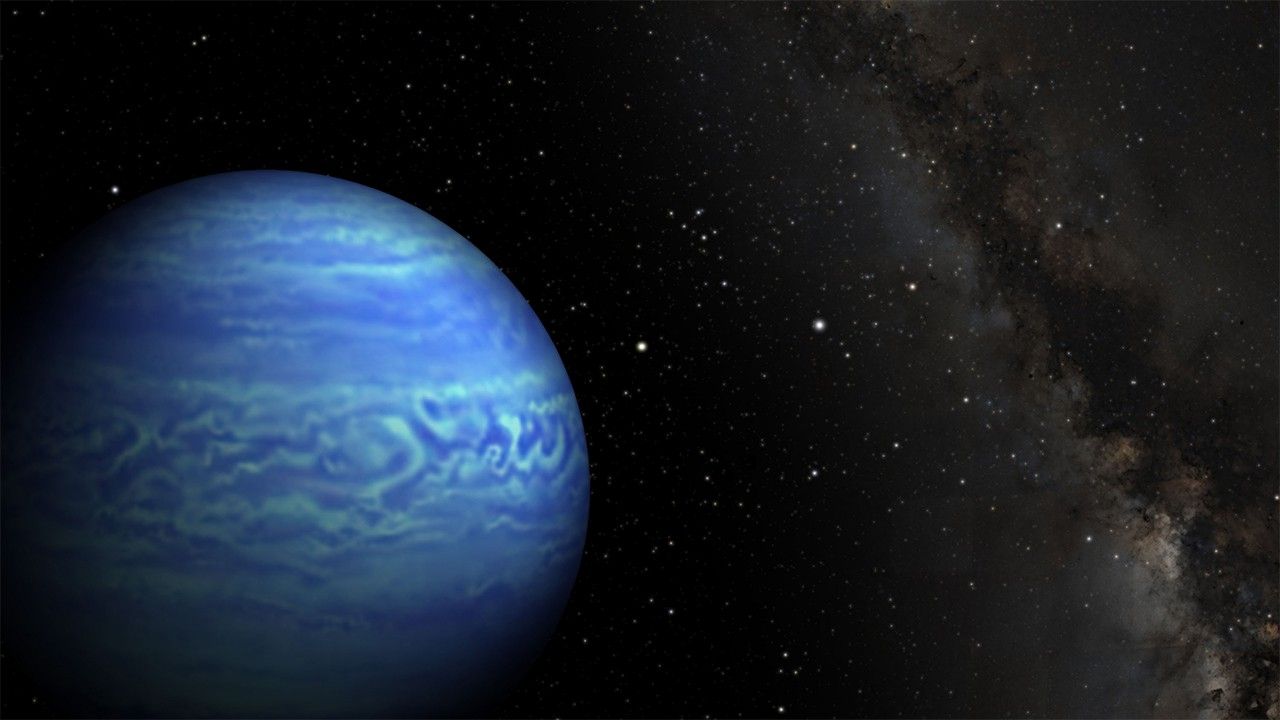
WISE 0855-0714
Neither star nor planet, this is a “brown dwarf,” a failed star about five times the size of Jupiter, and only 7.2 light-years from Earth. Detected in 2014, it’s the coldest known object outside of our solar system.
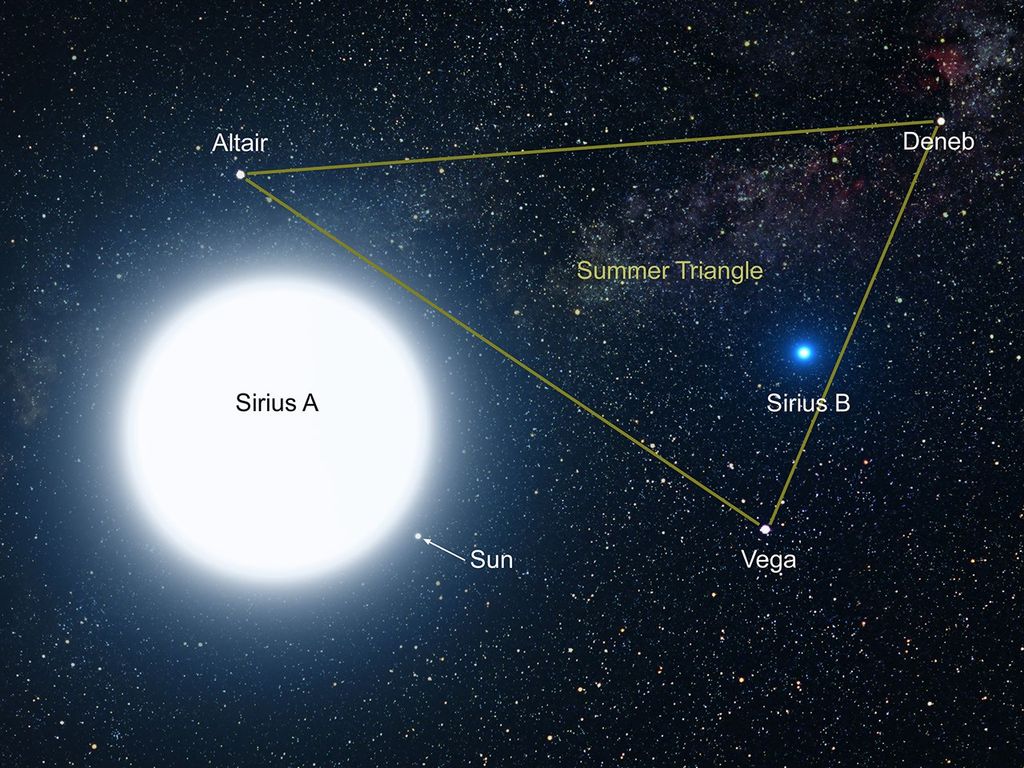
Sirius
The brightest star in our night sky, and also known as the “Dog Star,” Sirius is actually a binary system — Sirius A and the tiny companion Sirius B. About 8.6 light-years from Earth, it’s the fifth-closest stellar system.
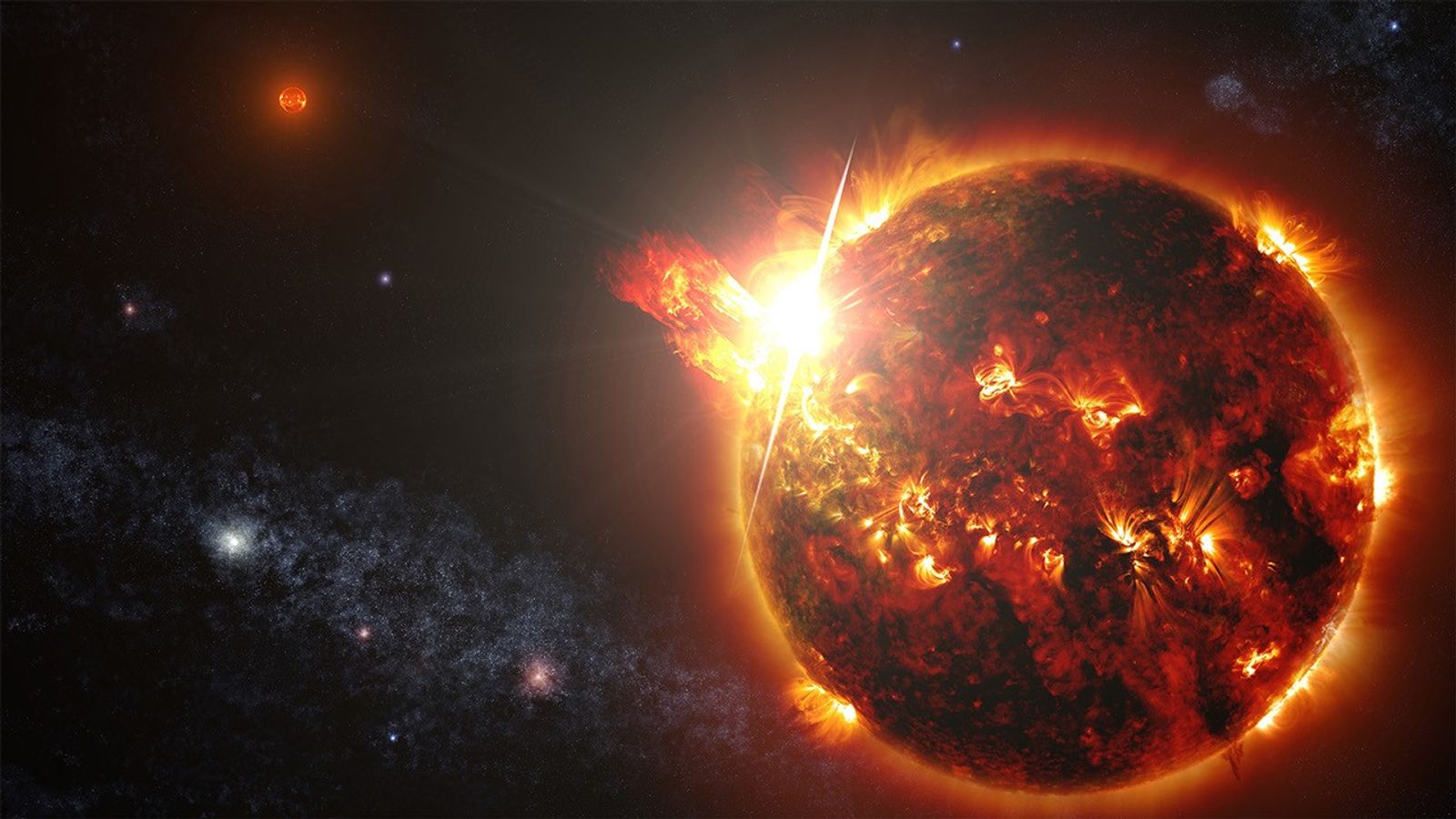
Wolf 359
Only 7.8 light-years away, one of the closest stars to our solar system, Wolf 359 is a red dwarf — also known as M-type, the most common stars in the universe — with a mass about one-tenth that of the Sun.

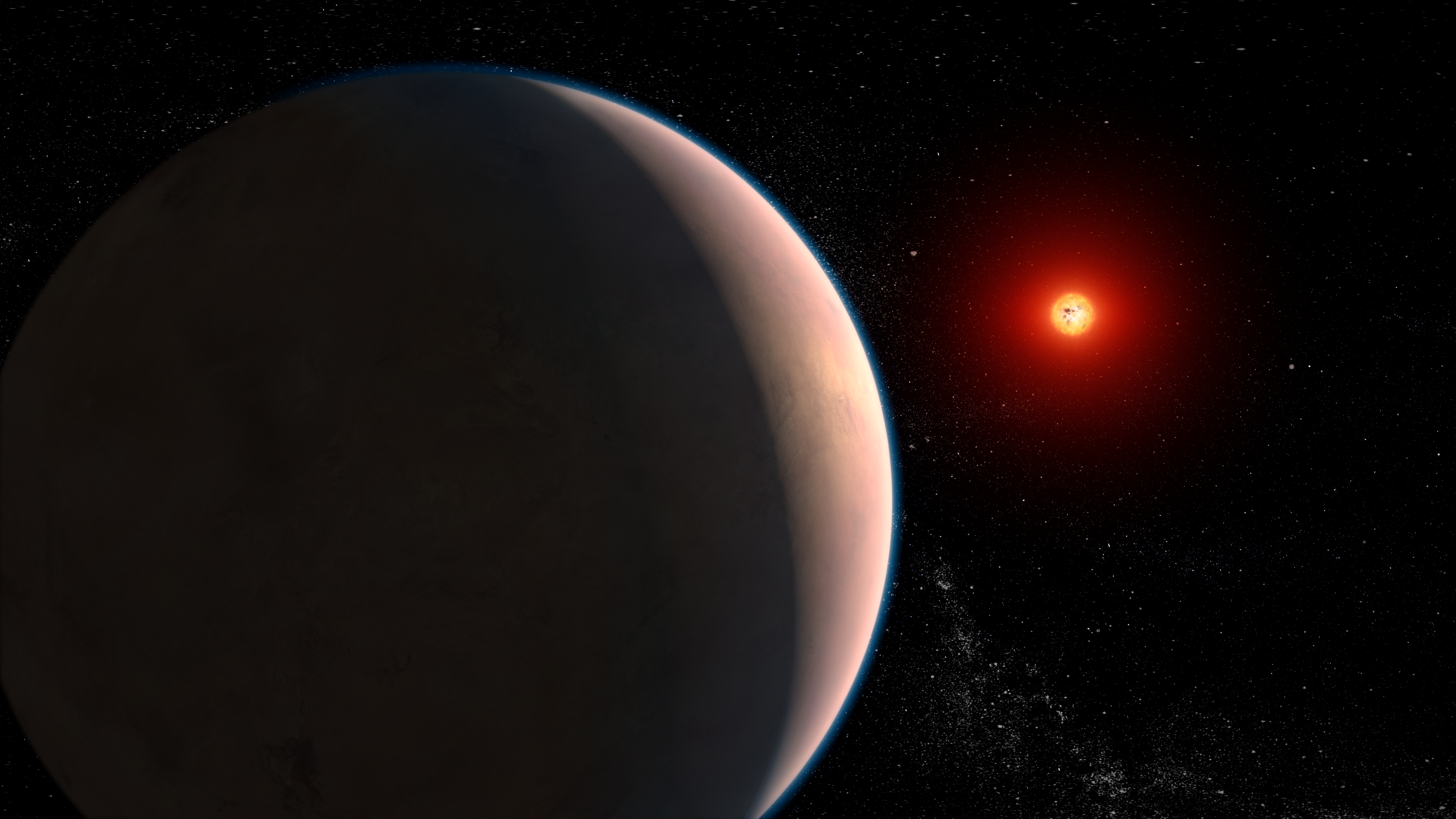
Ross 128
About 11 light-years away, Ross 128 is a red dwarf star that had a Super-Earth exoplanet (Ross 128 b, illustrated above) confirmed in 2017, which orbits the star in 9.9 days.
Lalande 21185
Another red dwarf, 8.3 light-years away; it’s also known as GJ 411 or HD 95735 and has two confirmed exoplanets to date.
John, Paul, George, and Ringo
Keep Exploring














 English (US) ·
  French (CA) ·