

 3 hours ago
1
3 hours ago
1
PROTECT YOUR DNA WITH QUANTUM TECHNOLOGY
Orgo-Life the new way to the future Advertising by AdpathwayOne week after evacuating from the wildfires that devastated parts of this eastern Washington city, Mareesha Backman handed over her youngest son to a stranger and took her first deep breath of relief.
Spokane public schools was hosting what has become a growing part of disaster response: a day camp for children of survivors. Backman showed up that first day feeling “stunned,” she said: hot, poorly showered and underslept. Thanks to the camp’s volunteers, she was able to go to a doctor’s appointment, run errands and simply sit in the air-conditioned quiet of a friend’s home.
“ This is going to sound so corny,” she said, tearing up at the memory. “It kind of felt like the hug that I needed was there. And I was going to be OK, and there were people there who wanted to support us, help us, and I didn’t have to figure it out on my own anymore.”
The wildfires, which began in early August, forced 60,000 people to evacuate and destroyed an estimated 920 structures. Spokane public schools reported that 169 students and 38 staff members lost their homes. So did an additional 20 students in the much smaller Nine Mile Falls school district, in a semi-rural wooded area north-west of the city.
With the effects of climate change intensifying, extreme weather is increasingly part of childhood. And, as fires, floods and storms rise, so too have networks and organizations to support children and families during such crises.
What’s called “education in emergencies”, or centering children’s needs in emergency response, is a best practice with its origins in international humanitarian aid, increasingly relevant here at home. Sarah Dryden-Peterson, who researches refugee education at the Harvard Graduate School of Education, said that beyond just providing childcare and safe supervision, education in emergencies ideally means “creating some predictable routines and structures so that the emergency and disaster can feel more understandable by young people”.
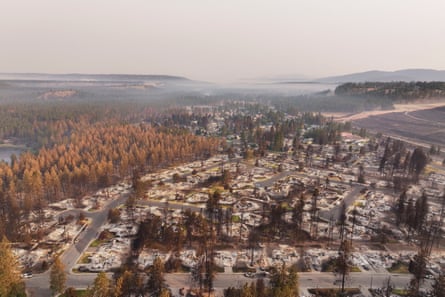
Within a day of the fire, public schools in the Spokane area had started collaborating with national nonprofits, local churches and small businesses to offer free day camp to any family affected by the fires. Spokane public schools also opened up one of its high schools as a resource center, offering everything from donated food and toiletries to assistance with filing insurance claims. School staff volunteered to supervise children in the auditorium and the gym; the district’s summer lunch program provided meals.
“As an educator, I feel it’s our moral imperative,” said Laurie Morrison, Spokane public schools’ chief academic officer. “When our students and their families are facing unimaginable devastation, we stand in the gap to offer even the slightest ease to their burden and to support their wellbeing. It’s an easy answer to, ‘If not you, then who?’”
Within a few days, Spokane public schools was joined by a nonprofit called Project:Camp, whose entire mission is popping up free day camps in the wake of disasters.
Project:Camp cofounder Mikey Latner, compact and curly haired, said the Covid pandemic underscored the importance of childcare and schools to communities, society and the economy. His organization has mounted 33 post-disaster camps in 10 states since 2021, hopscotching from Hurricane Ian in Florida to the Maui and Los Angeles wildfires to tornadoes in Kentucky.
Jeff Baerwald, superintendent of the Nine Mile Falls school district north-west of Spokane, was shocked at how fast they reached out to him. “I very jokingly, positively call them ambulance chasers for the good,” he said. In Spokane, Project:Camp served hundreds of children at two locations over the course of three weeks before shutting down so the school buildings could be readied for the start of the semester.
On a hot, dry Monday morning two weeks after the fire, more than 100 children checked in for the day at Project:Camp’s second Spokane location, Lake Spokane elementary in the Nine Mile Falls school district. While the tweens played outside, the little kids sat cross-legged in the gym, in thrall to Abby Cadabby, the pink-haired fairy from Sesame Street. Leslie Carrara-Rudolph, Abby’s helium-voiced performer, had quietly flown out from New York City.
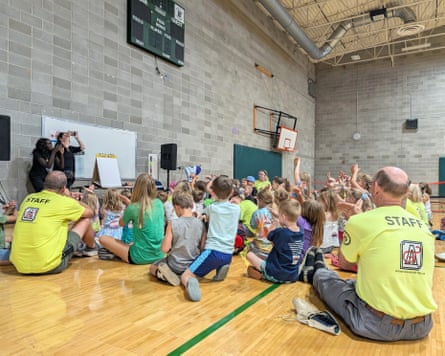
Besides meeting Abby, the kids played laser tag, petted therapy dogs and even fed some live buffalo. These bells and whistles are nice but not necessary, said Latner, whose background is in traditional summer camp. His group can fly in and set up a camp with no more than two plastic totes of basic supplies, like T-shirts and name tags. The rest tends to come from donations, and maybe a local Walmart run. What matters most, said Latner, is getting parents to trust them with their kids in a stressful situation. That means collaborating with familiar groups: schools, churches, World Central Kitchen, the Red Cross, YMCA, and Boys & Girls Clubs.
When the recipe works right, national groups bring resources, expertise from multiple disasters and fresh energy; local groups bring cultural competence and personal relationships. “Looking at it from the small, rural community perspective, outsiders aren’t always going to be embraced,” said Baerwald. The key here in Nine Mile Falls, he said, was teaming up with local churches.
Project:Camp isn’t designed overtly as a therapy camp. It makes referrals to local clinicians when appropriate. The setup is instantly familiar: The volunteer staff divide children into “cabins” by age and rotate them through sports, games, and arts and crafts on a set schedule. Latner references the science of “adverse childhood experiences”, or ACEs. He said he’s learned that “one of the key tenets is returning kids to a sense of safety and normalcy and routine, reestablishing relationships. So we focus on those kinds of moments throughout the day.”
As the Backman family’s experience makes clear, those who lose homes or school days are not the only children affected by disasters. While evacuating, they drove through smoke that turned day to night. They saw a house engulfed in flames. The family of seven wound up on a Christmas tree farm in Idaho, crammed into their old travel trailer.
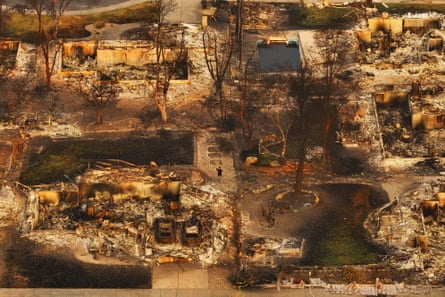
“The batteries blew, exploded. So our fridge in the camper died. We had no running water. We had no running toilet. We were just living in a hot box. And out in the smoke and the heat most of the day,” said Backman. The kids regressed, clinging, fighting, waking up with night terrors. It was all especially hard on 7-year-old Bennett, who is slight, flaxen blond and medically fragile, with a feeding tube.
Backman’s family was ultimately evacuated for nine days, but she still felt lucky. Her husband, Chris, happens to work for Spokane public schools, in administration at Holmes elementary, where four staff members and at least one student lost their homes. Latner emphasizes that their camps are intended to welcome everyone affected by an emergency, directly or indirectly.
It was a Project:Camp gratitude circle that first made Backman realize the enormity of what her children had been through. Driving home on the second day, she asked the boys how their day had gone. Bennett spoke up; she recounted: “‘Well, we just did this thankfulness circle, and I told them I was just glad I didn’t die in the fires.’ And my brain went, ‘Oh my gosh, my children are traumatized.’” Though it was hard to hear, she was grateful to have the conversation started. “Going to camp meant they were surrounded by adults who a) love kids and b) brought in this kind of trauma-informed practice,” Backman said.
By Day 18 after the fire, Project:Camp’s team was packing up and considering their next stop – maybe the tropical storm in Hawaii or a flood in Indiana. In the meantime, local organizations in Spokane are thinking ahead about the long-term needs of the children in the area.
Baerwald, the superintendent of the Nine Mile Falls district, said every child in his district has been affected by the fire in some way. He hopes to help the community regenerate just as the landscape will.
“I’m driving past this burn scar right now. I see it multiple times a day. And we’ll start seeing new growth come back, but that will take some time. That will also be part of the healing process.”
This story about Project:Camp was produced by the Hechinger Report, a nonprofit, independent news organization focused on inequality and innovation in education. Sign up for the Hechinger newsletter.
















 English (US) ·
  French (CA) ·