

PROTECT YOUR DNA WITH QUANTUM TECHNOLOGY
Orgo-Life the new way to the future Advertising by AdpathwayUniversity of Minnesota researchers flew autonomous, student-built drones to sample and analyze smoke plumes to help firefighters predict spread, improve tactics and manage prescribed burns
November 15, 2025 08:00 AM

Department of Natural Resources staff light a backfire as University of Minnesota researcher Nikil Krishnakumar prepares drones to fly in the smoke at Cedar Creek Ecosystem Science Reserve in East Bethel, Minnesota, on Oct. 24, 2025.
Renée Jones Schneider/TNS
By Alex Chhith
Star Tribune
EAST BETHEL, Minn. — Plumes of smoke drifted up from a fire steadily taking over a 30-acre prairie at Cedar Creek Ecosystem Science Reserve, north of the Twin Cities. Amid the haze, five black drones zipped around.
More than 150 feet below the flying robots, research student Nikil Krishnakumar raised the controller in the air.
“It’s all autonomous now,” he said. “I’m not doing anything.”
| MORE: Drones for fire service: Real-time insights & safety
The aerial robotic team’s mission: examine the smoke from the prescribed burn and send the data to a computer on the ground. The computer then analyzes the smoke data to understand the fire’s flow patterns, Krishnakumar said.
The University of Minnesota project is the latest research into using artificial intelligence to detect and track wildfires. The work has become more urgent as climate change is expected to make wildfires, like those that devastated Manitoba this summer, larger and more frequent.
NOAA’s Next-Generation Fire System consists of two satellites 22,000 miles above the equator that detect new sources of heat and report them to local National Weather Service stations and its online dashboard. Earlier this year, the satellites were credited with spotting 19 fires in Oklahoma and preventing $850 million in structure and property damage, according to the agency.
In Minnesota, Xcel has installed tower-mounted, AI-equipped high-definition cameras near power lines in Mankato and Clear Lake. Thirty-six more are planned. When a fire is detected, local fire departments are notified.
Krishnakumar and other members of the U’s research team performed their 11th trial at the U’s field station in East Bethel on Friday, with notable improvements from their previous attempts.
The first-generation drones crashed several times during previous field tests, Krishnakumar said. The team upgraded sensors for better data collecting and autonomous steering, and improved the drones’ propulsion by making them bigger and fitting them with better propellers.
“The big picture is one day these drones can be used to understand where the wildfires go, how they behave and to perform large-scale surveillance of wildfires,” Krishnakumar said. “The major challenge we’re trying to understand is how far these smoke particles can be transported and the altitude in which they can go.”
Understanding the behavior of particles like embers can help firefighters prevent wildfires from spreading, said Yue Weng, another researcher on the team.
Though the project has a way to go before it can be used for large-scale wildfires, the research represents a significant step toward using fully autonomous drone systems for emergency response and scientific research missions, said Jiarong Hong, professor at the University of Minnesota’s Department of Mechanical Engineering.
This year, 1,200 wildfires have been recorded in Minnesota so far, according to the state Department of Natural Resources. On a smaller scale, the technology could also be used to better manage prescribed burns, Hong said. Between 2012 and 2021, prescribed burns that went out of control caused 43 wildfires nationwide, according to the Associated Press.
“To characterize and measure particle transport in the real field is very challenging. Traditionally, people do small-scale lab experiments and study this at a fundamental level,” Hong said. “Such an experiment doesn’t capture the complexity involved in the real field environment.”
Smoke changes direction with the wind. Deploying multiple drones — with one at the center managing the four around it — enables them to navigate in the air without human intervention, Hong said.
The 11-pound drones were custom-built by the students to autonomously collect particle data. Future improvements to the project, which was funded by the U and the National Science Foundation, include collecting more data and extending the battery life of the drones. The drones are currently able to operate in the air for about 25 minutes, less in colder temperatures, Hong said.
“We have drones flying out at different heights, so we can actually measure the particle composition at different elevations at the same time,” Hong said. “Particles are in a very irregular shape and some of them are porous and have varying levels of density. But we have been able to characterize their morphology and shape for the very first time.”

A push to return EMS back to its own agency is gaining momentum amid response times, pay parity demands and warnings from FDNY leadership that a breakup could add cost and complexity
November 14, 2025 11:14 AM
·

Caughey was presented the John M. Buckman III Leadership Award at the IAFC’s Symposium in the Sun conference
November 13, 2025 03:52 PM
·

Deliberations begin in a wrongful death case alleging Rock Falls chiefs showed willful, wanton disregard in the 2021 fire that killed Sterling Lt. Garrett Ramos
November 14, 2025 09:13 AM

FDNY members honored Firefighter Patrick Brady with a dignified transfer after his death from cardiac arrest at a Brooklyn fire
November 14, 2025 08:29 AM
·
©2025 The Minnesota Star Tribune.
Visit startribune.com.
Distributed by Tribune Content Agency, LLC
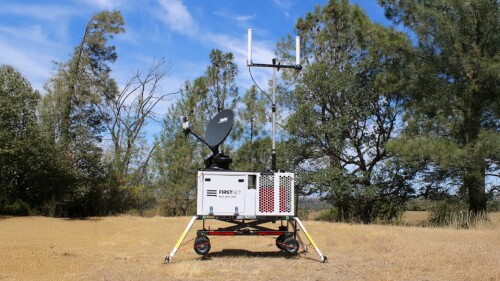
AT&T’s FirstNet deployable network provides mission-critical connectivity through mobile satellite solutions and portable infrastructure
November 03, 2025 11:04 AM
















 English (US) ·
  French (CA) ·