

 4 days ago
22
PROTECT YOUR DNA WITH QUANTUM TECHNOLOGY
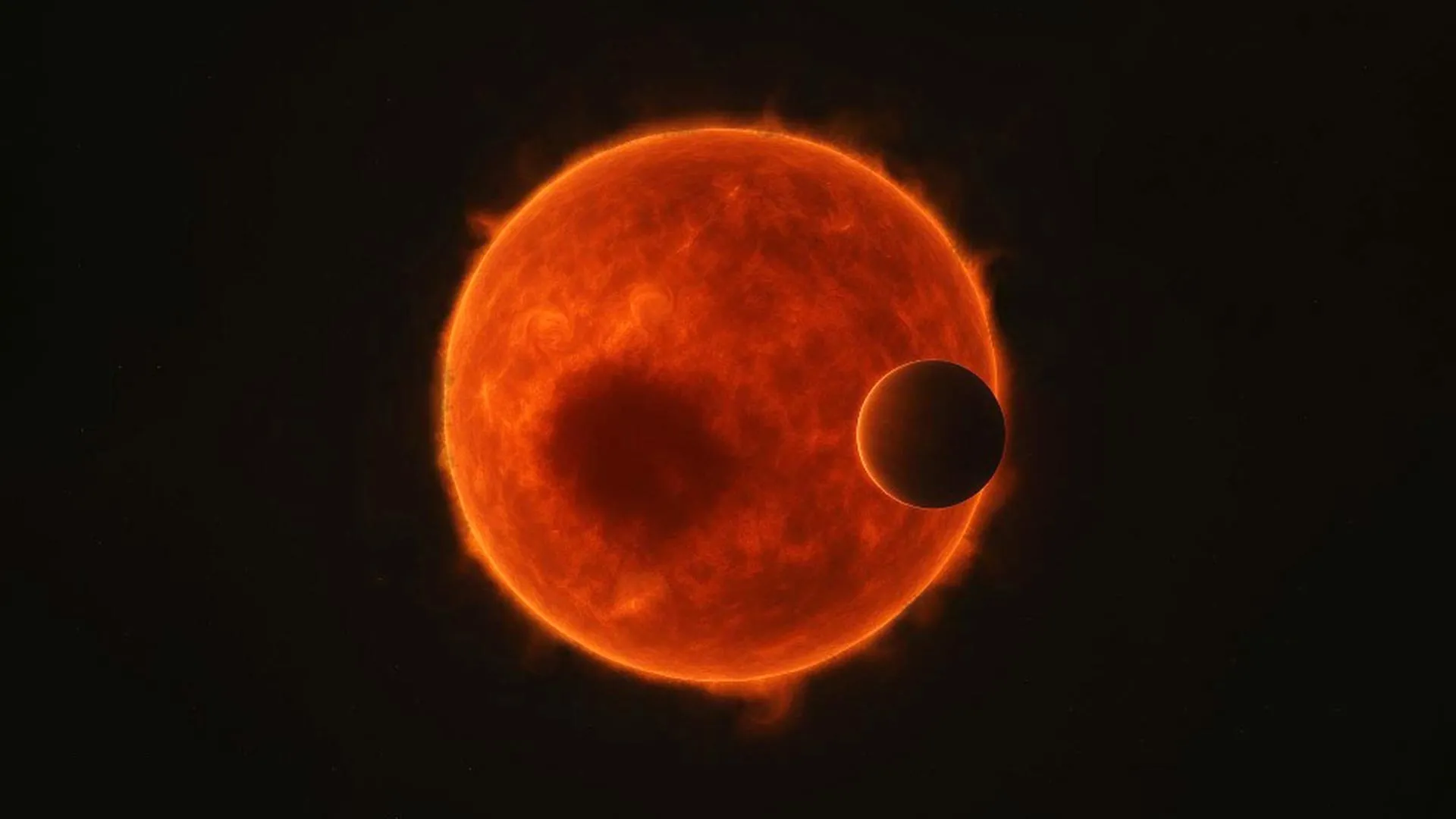
Orgo-Life the new way to the future Advertising by AdpathwayA rocky planet so close to its star that its surface is likely an ocean of molten rock appears to be wrapped in reflective clouds of glassy minerals, according to new observations from NASA's James Webb Space Telescope. The planet, TOI-561 b, reflects roughly 75% of the starlight that hits it, about as much as Venus, astronomers reported in The Astronomical Journal, according to a University of Birmingham release issued Oct. 27.
The finding adds to a puzzle — a small planet blasted by this much radiation should have lost any atmosphere long ago. Instead, the new data strengthen the case that TOI-561 b still has a thick one, possibly fed by gases escaping from its magma ocean.
Lava worlds like this one offer a window into a stage that rocky planets, including the early Earth, may pass through. Learning how an atmosphere survives on a planet like TOI-561 b could help scientists understand how rocky worlds hold onto air and water at all.
A Planet Cooler and Brighter Than It Should Be
TOI-561 b is about 280 light-years away and slightly larger than Earth, at about 1.4 times Earth's width and roughly 2.2 times its mass. It circles an ancient star, at least 10 billion years old, in about 10.7 hours, far closer than Mercury orbits the Sun.
The planet's density, about 4.3 grams per cubic centimeter, is lower than expected for an Earth-like mix of rock and iron. Carnegie Science astronomer Johanna Teske, who led a 2025 analysis of the same Webb data, has said that low density is what sets the planet apart, and it may point to a small iron core. Its old, iron-poor host star suggests TOI-561 b formed early in the galaxy's history from different raw materials than the solar system.
Webb's NIRSpec instrument watched the planet for about 37 hours, nearly four full orbits, tracking how its light changed as it swung around the star. That method, called a phase curve, lets astronomers measure both the day side and night side. Project lead Lisa Dang of the University of Waterloo said the planet reflects a significant amount of light from its star, according to ScienceDaily.
The day side measured about 2,050 Kelvin, roughly 3,200 degrees Fahrenheit, according to the study preprint on arXiv. A dark, airless rock in the same orbit would be expected near 3,200 Kelvin, more than 1,000 degrees hotter. A bright, high-albedo atmosphere that bounces light away and moves some heat around the planet can explain the gap.
Clouds Made of Melted Sand
The team compared the data with climate models and found that clouds of silicon dioxide, the main ingredient in quartz and sand, and magnesium silicate could produce the high reflectivity. These are the same kinds of minerals that make up rock on Earth, condensing as glassy droplets or grains in a superheated sky.
The clouds act like a planet-wide sunscreen, reflecting light before it reaches the molten surface. But the cloud makeup comes from modeling, not a direct detection, and the reflectivity itself is inferred from how much heat the planet appears to absorb and redistribute.
Anjali Piette, an assistant professor of astronomy at the University of Birmingham and a co-author, said in the release that astronomers would expect such a heavily irradiated rocky planet "to have lost its atmosphere billions of years ago." The evidence points the other way.
Venus or a Supersized Io
The leading idea is that the magma ocean acts like a planet-wide volcano, continuously releasing gases that replace what the star strips away. Earlier Webb results published in December 2025 had already found signs of a thick, volatile-rich atmosphere on TOI-561 b, with co-author Tim Lichtenberg of the University of Groningen calling it "really like a wet lava ball," according to NASA.
The open question is what the atmosphere is made of — one option is a thick carbon dioxide atmosphere like Venus's, only far hotter. The other is an atmosphere dominated by sulfur dioxide, the volcanic gas that cloaks Jupiter's moon Io. Dang said the next big question is "whether TOI-561 b's atmosphere resembles Venus or an extreme version of Io."
A companion modeling study by several of the same researchers found that both scenarios are possible, with the deciding factor being how much sulfur the planet contains. That paper has been posted as a preprint, and its peer-review status has not been confirmed.
Limits of the Evidence and Next Observations
No specific gas has yet been detected in TOI-561 b's atmosphere. The silicate clouds, the Venus-like reflectivity and the outgassing magma ocean are the best explanation for the measurements, but each rests on models fitted to a single set of observations from May 2024.
Observing at longer infrared wavelengths, for example with Webb's MIRI instrument, could reveal the signature of carbon dioxide and help settle the Venus-versus-Io question. No such observation has been publicly scheduled. No independent researchers outside the study team have yet commented publicly on the results.
The work was supported by NASA through the Space Telescope Science Institute, the Canadian Space Agency and Canada's Natural Sciences and Engineering Research Council. The research team spans universities in the United Kingdom, Canada, the United States, Australia and the Netherlands.
The bottom line: Webb's longest look yet at TOI-561 b suggests a bright, cloudy atmosphere shading a molten surface on a planet that should be bare. The clouds and the gas supply are still inferred, not confirmed, and the next test is whether carbon dioxide or sulfur dioxide dominates its sky.
What Readers Want to Know
What is TOI-561 b? A rocky exoplanet about 280 light-years away, slightly larger than Earth, that orbits its star in about 10.7 hours and likely has a magma ocean.
What did Webb find? The planet reflects about 75% of starlight, similar to Venus, and its day side is far cooler than a bare rock should be.
What are the clouds made of? Models point to silicon dioxide and magnesium silicate, glassy minerals related to sand and rock. They have not been directly detected.
Why is its atmosphere surprising? Intense radiation should have stripped it away long ago. The magma ocean may be continuously releasing gas to replace it.
What is the Venus versus Io question? Whether the atmosphere is mostly carbon dioxide, like Venus, or sulfur dioxide, like volcanic Io.
What comes next? Longer-wavelength Webb observations could detect carbon dioxide, but none has been publicly scheduled.
© 2026 NatureWorldNews.com All rights reserved. Do not reproduce without permission.













 English (US) ·
 French (CA) ·