

PROTECT YOUR DNA WITH QUANTUM TECHNOLOGY
Orgo-Life the new way to the future Advertising by AdpathwayThe kraken — a gigantic, tentacled sea monster capable of dragging ships and sailors down into the depths — is a creature of Norwegian myth. But millions of years ago, a similar real-life animal lurked in the deep.
Fossilized jaws reveal that enormous octopuses growing up to 19 meters long were top predators in the oceans during an era when dinosaurs ruled on land. These super-sized cephalopods would have been the largest marine animals of the Cretaceous Period and may be the biggest invertebrates to ever live, researchers report April 23 in Science.
It’s difficult to study fossil octopuses because most of their soft bodies often decompose before fossilization, says Yasuhiro Iba, a paleontologist at Hokkaido University in Sapporo, Japan. Precious few hard parts, like their beaklike jaws, are left behind to fossilize.
Some particularly large fossil jaws had been found by researchers in Japan and Canada’s Vancouver Island. These date back to the Late Cretaceous Period — about 72 million to 100 million years ago, during the twilight of the age of dinosaurs. The jaws appeared to belong to octopus-like creatures, but their precise classification and any details on their size in life and possible role in the ecosystem remained mysterious, Iba says.
Iba and colleagues took a new look at 15 fossil cephalopod jaws to carefully measure them and compare them with those from other extinct and living octopus and squid species. They also used a special technique to discover and document 12 more jaw fossils embedded in rocks found in Japan. The rocks were ground down layer by layer and photographed at each step. With the aid of artificial intelligence, the team created a detailed digital model of fossils too fragile to mine out using traditional methods.
While these 27 cephalopods were initially thought to be from five different extinct species, the researchers reassigned them as just two: Nanaimoteuthis jeletzkyi and the much larger N. haggarti. Based on comparisons with other cephalopod jaws, the creatures appear to be early finned octopuses. Today’s finned octopuses, such as the dumbo octopus, are deep-sea animals with webbing between their arms as well as flapping fins on the other end of their body.
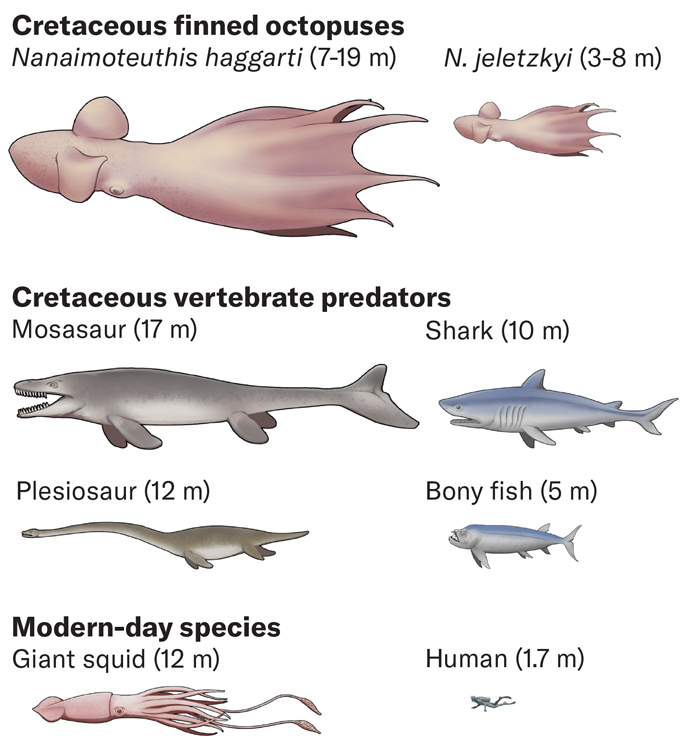
But their ancient relatives were clearly much larger. The largest lower jaw belonging to N. haggarti could cradle a grapefruit and was about 50 percent bigger than that of the 12-meter-long modern giant squid, one of the largest cephalopods alive today. Iba and colleagues estimate that once you include N. haggarti’s billowing umbrella of arms, it could have been between about seven and 19 meters long.
The animal “may have been among the largest invertebrates in Earth’s history,” Iba says.
N. haggarti might have rivaled or exceeded the size of the biggest marine predators in the ocean at the time, including huge reptiles like mosasaurs and long-necked plesiosaurs.
Going big
The massive octopus N. haggarti may have topped the size of the biggest marine predators in the ocean at the time of the dinosaurs, including enormous reptiles. At up to 19 meters long, it also dwarfs today’s giant squid, possibly making it the largest invertebrate known.
 Hokkaido UniversityHokkaido University
Clues in the fossil jaws also suggest the octopuses probably competed with these top tier predators for a spot in the food chain. The researchers found consistent wear and damage in the jaws, suggesting the octopuses were powerful and voracious predators routinely biting on shells and bones.
The discovery may mean that ancient marine ecosystems were more complex and had a wider range of predators than previously thought.
“For a long time, the top of the marine food web has been thought to be dominated by large vertebrates,” Iba says. “Our study shows that giant invertebrates — octopuses — also occupied that role in the Cretaceous.”
Christian Klug, a paleontologist at the University of Zurich, says that since there are incomplete remains and the researchers had to go off fossil jaws alone, it’s possible Nanaimoteuthis was a bit smaller. But, he says, “there is no doubt that these animals ranged among the top predators.” Future findings may help determine these beasts’ precise ecological roles, he adds.
Adiël Klompmaker, a paleontologist at the University of Alabama in Tuscaloosa, hopes some giant octopus fossils will turn up with stomach contents preserved.
“That would tell us what they ate,” he says. “Shelly invertebrates such as large ammonites, or did they also go after large vertebrates?”
Only time and the ongoing work of paleontologists will release more “kraken” secrets.













 English (US) ·
  French (CA) ·