

PROTECT YOUR DNA WITH QUANTUM TECHNOLOGY
Orgo-Life the new way to the future Advertising by AdpathwayAmber fossils preserve tiny paddles on the lower leg that could have powered each stroke
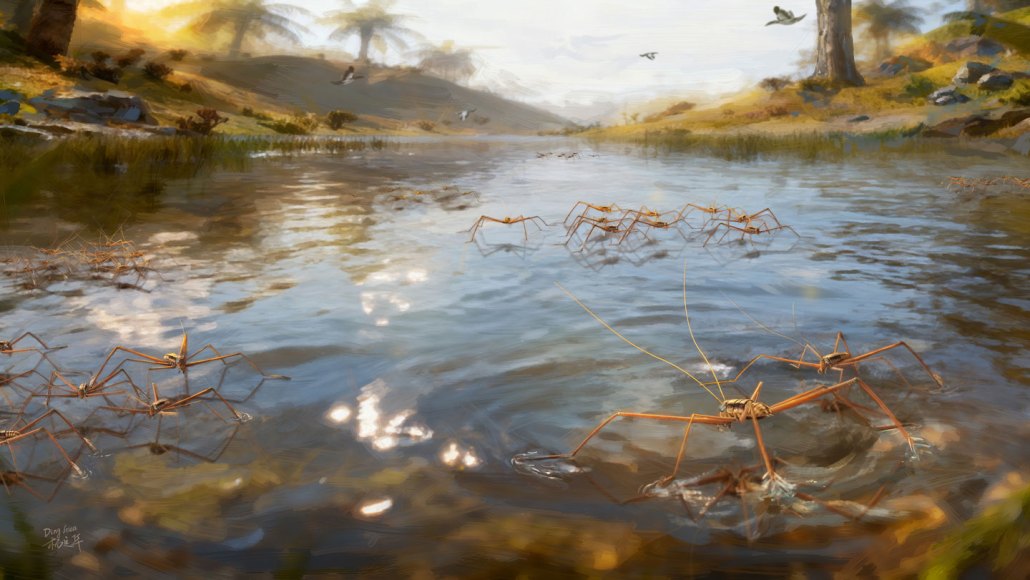
Ancient grasshoppers with spindly legs glide across water in this illustration, similar to how they may have scooted nearly 100 million years ago.
Dinghua Yang
Nearly 100 million years ago, spindly legged grasshoppers may have scooted across water like modern day water striders. The clues are in the fossilized insects’ legs and feet.
Special hairs and leaf-shaped leg adornments, exquisitely preserved in amber, suggest the insects — members of a newfound family of insects — could balance and slide around on surface tension, researchers report November 24 in Proceedings of the Royal Society B. The discovery suggests at least three insect groups evolved independently to move across water.
Paleontologist Chunpeng Xu and his colleagues first encountered the strange insects while studying a collection of 99-million-year-old amber. Frozen in time were three pieces of amber containing wingless grasshoppers with short bodies and incredibly long, skinny legs. Due to their unorthodox body shape, Xu didn’t recognize them as grasshoppers at first and thought they might be harvestmen or stick insects.
“I was genuinely amazed,” says Xu, of the Nanjing Institute of Geology and Paleontology in China. “They are among the most bizarre insects.”
Under the microscope, two details stood out: Front legs with water repellant hairs and rear lower legs with leaf-shaped paddlelike structures. Estimates of the insects’ weight show they could have ridden on the water’s surface tension, with help from the repellant hairs on their legs and their spread-out footprint across the surface of the water. And the paddlelike lower legs would have propelled them forward.
The researchers named the insects Hydrelcana zhangi, placing them in the new family Hydrelcanidae.
“Walking on water is a pretty rare skill in nature,” Xu says. Until now, only two insect groups were known to have evolved to live on the water’s surface: water striders and their kin, and a similar looking but unrelated, long extinct family called Chresmodidae.
The grasshoppers had a different gait from other water-walking insects. The common pond skater (Gerris lacustris), by comparison, rows with its middle limbs.
And whereas modern water-walking insects are predators and scavengers, the ancient grasshoppers were also probably herbivorous, given their mouthparts and lack of claws. The researchers found nine of them preserved in the same amber chunk, suggesting the insects may have gathered in large numbers to feed. It’s possibly the earliest record of such swarming behavior in grasshoppers or crickets, the team says.















 English (US) ·
 French (CA) ·