

 16 hours ago
7
PROTECT YOUR DNA WITH QUANTUM TECHNOLOGY
Orgo-Life the new way to the future Advertising by AdpathwayFor decades, a common story about early animal life held that the deep ocean filled with oxygen around 540 million years ago, setting the stage for an explosion of complex creatures. A study of ancient seafloor mud from Canada's Yukon suggests that switch never flipped cleanly.
Using thallium isotopes as a chemical fingerprint, a University of Utah-led team found deep-ocean oxygen rose and fell repeatedly between about 485 and 380 million years ago, long after animals had diversified. Oxygen-rich deep water appeared only in brief episodes before the ocean slipped back into widespread low-oxygen conditions.
One important note on timing: the study was published in Science Advances in September 2025 and is receiving renewed attention this month. It is not a discovery, but its findings remain relevant as scientists track oxygen loss in today's oceans.
How Thallium Records Ancient Oxygen
Oxygen itself does not survive in rock for hundreds of millions of years, so researchers rely on stand-ins. Thallium is a trace metal with two isotopes of slightly different weight.
Manganese minerals that settle onto the seafloor pull more of the heavier thallium isotope out of seawater. Those minerals only persist where oxygen is steadily present at the seafloor, since even a few days without oxygen can dissolve them. When large areas of the deep seafloor are oxygenated, seawater, and the mud that forms from it, become enriched in the lighter isotope.
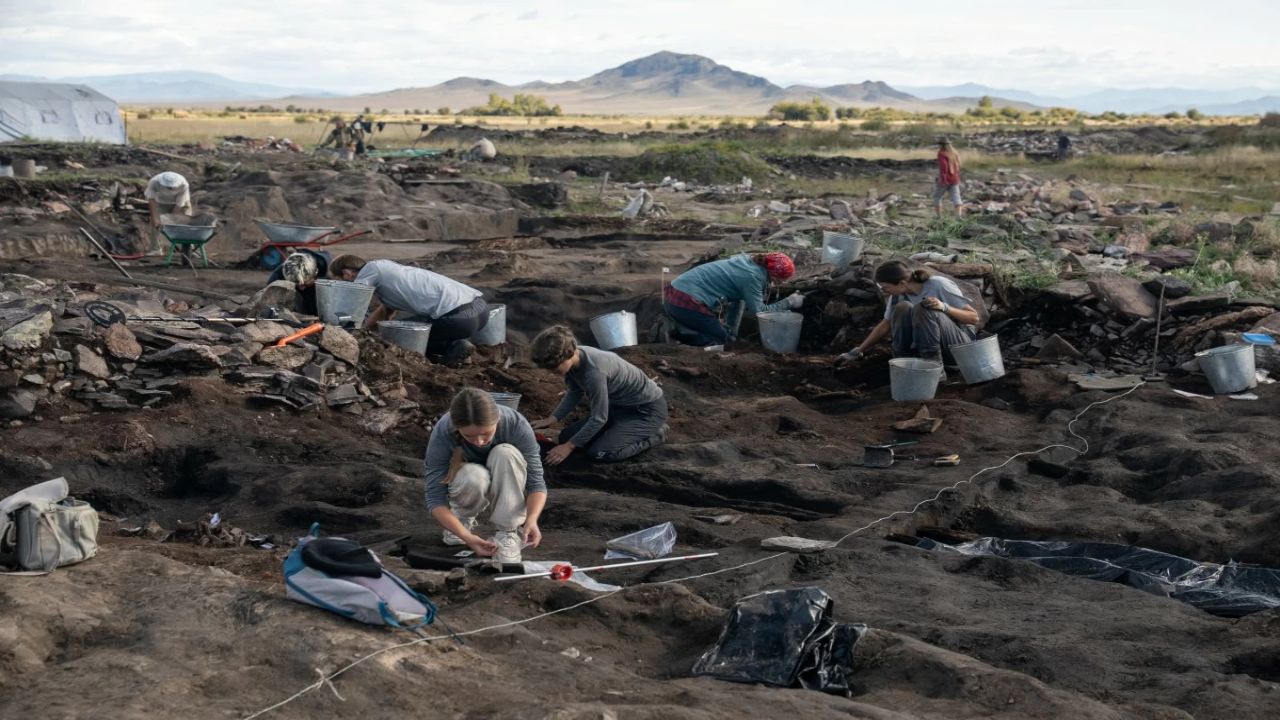
By measuring that ratio in ancient shales, scientists can estimate how much of the global seafloor sat under oxygen-rich water. The team analyzed 82 shale samples from the Peel River area of the Yukon, plus 44 from Latvia, Libya, Wales and Montana, according to Earth.com.
A Timeline That Overturns the Textbook Picture
Most of the record matched values typical of ordinary continental rock, consistent with little oxygen in deep water. One notable exception appeared between about 405 and 386 million years ago, when readings suggested oxygen-rich water covered well over 30 percent of the seafloor. The lowest value came from the Marcellus Shale in the Appalachian Basin, formed about 388 million years ago.
That oxygen did not last. By about 378 million years ago, the record returned to ordinary values. The Yukon readings during the oxygen-rich interval resembled values recorded at the peak of the last ice age, a time when cold, well-mixed oceans carried abundant oxygen to depth.
"It wasn't like someone flipped a switch and the deep ocean became forever oxygenated," lead author Chadlin Ostrander, an assistant professor of geology and geophysics at the University of Utah, said in a university release. He said the new dataset pushes the timing of a lasting deep-ocean oxygenation forward by at least about 160 million years.
The work builds on other research questioning the classic story. A 2024 study whose senior author was Stanford geobiologist Erik Sperling, who also led expeditions that collected the Yukon samples, used molybdenum and uranium records to argue that deep-ocean oxygen did not reach modern levels until the Devonian period, ScienceAlert reported. Sperling's team concluded that Cambrian animals likely needed less oxygen than scientists once believed.
Getting oxygen into deep water is harder than oxygenating the surface. It requires cold, oxygen-rich water to sink near the poles and low rates of respiration as that water travels — conditions that may have come and gone with changing climate, sea levels and nutrient supply.
What It Means for Early Animal Evolution
The sampled window covers a period when marine life was already large, mobile and energy-hungry, including a second great burst of marine diversity between roughly 485 and 444 million years ago. If deep water stayed mostly low in oxygen through much of that time, animals evolved under tighter constraints than scientists assumed.
Ostrander argues that major evolutionary changes in this period did not require substantial, sustained deep-ocean oxygen. Shallow seas, which exchange gas with the atmosphere, could have been oxygenated while the depths were not, giving animals livable habitat near the surface.
The study has clear limits. Samples average roughly one per 450,000 years, so short swings could be missed. The team also could not fully rule out that thallium cycled too quickly for the mud to reflect the whole ocean, though they consider this unlikely. And the record begins after the Cambrian, so it does not directly test conditions during the Cambrian explosion itself. When the deep ocean became permanently oxygenated remains unknown.
The Modern Parallel: An Ocean Losing Oxygen
The ancient record has a present-day echo. Scientists estimate the global ocean has lost about 2 percent of its oxygen since the 1960s, and a 2018 review in Science found that open-ocean zones with no oxygen have roughly quadrupled over the past half century, while low-oxygen coastal sites have multiplied.
Warmer water holds less oxygen and mixes less with deeper layers, and nutrient runoff from farms and sewage fuels algae blooms whose decay consumes oxygen. In the U.S., the Gulf of Mexico and Chesapeake Bay experience recurring summer dead zones that affect fisheries and coastal economies.
The Paleozoic study does not model today's ocean — and it does not predict future conditions. What it does show is that ocean oxygen has not been a fixed background condition for life. It has shifted repeatedly, and marine ecosystems have had to cope with those shifts.
For readers, the takeaway is that the oxygen supply in the deep sea was never guaranteed. Tracking how quickly it is changing now, through ocean monitoring and nutrient reduction programs, remains one of the clearer ways to protect fisheries and coastal communities.
What Readers Want to Know
What did the study find? Deep-ocean oxygen rose and fell repeatedly between about 485 and 380 million years ago instead of rising permanently around 540 million years ago.
How can rocks show ancient oxygen levels? Thallium isotope ratios in seafloor mud reflect how much of the seafloor was covered by oxygen-rich water when the mud formed.
Is this a new study? It was published in Science Advances in September 2025 and has recently drawn renewed attention.
Does this change the story of early animals? It suggests animals diversified with less deep-sea oxygen than once assumed, though the samples begin after the Cambrian explosion.
Is the modern ocean losing oxygen? Yes. Scientists estimate about 2 percent of ocean oxygen has been lost since the 1960s, and low-oxygen zones have expanded.
When did the deep ocean become permanently oxygenated? That remains unknown. The researchers say it happened sometime after about 380 million years ago.
© 2026 NatureWorldNews.com All rights reserved. Do not reproduce without permission.











 English (US) ·
 French (CA) ·