

 18 hours ago
1
PROTECT YOUR DNA WITH QUANTUM TECHNOLOGY
Orgo-Life the new way to the future Advertising by Adpathway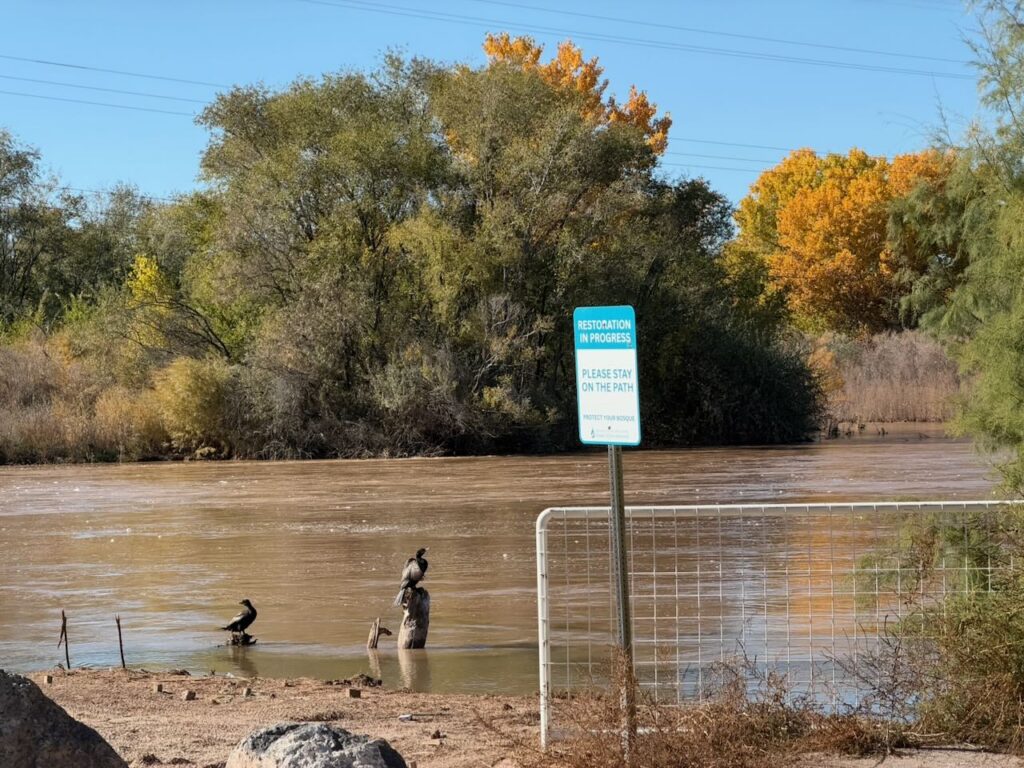
Saw four cormorants and four humans fishing at the Albuquerque wastewater treatment plant outfall to the Rio Grande this morning.
Accumlating odds and ends, cluttering my brain but lacking the oomph for a full blog post:
With work getting underway on the replacement of the Rio Bravo Bridge over the Rio Grande in greater Albuquerque’s South Valley, a bit of spelunking in one of the Internet’s unlit subterranean passages yielded this bit of treasure, from a 1992 oral history interview with Jerry Verkler, a former staffer to the late Clinton P. Anderson, who represented New Mexico in the United States Senate from 1949 to 1973.
He made his money in the insurance business, and was a very influential figure in the state of New Mexico selling insurance bonds to highway contractors, etc. But there was a bridge built–the second bridge across the Rio Grande in the valley south of Albuquerque–and it went right across the river about half a mile from his farm–his spread. I always thought that was a happy coincidence. [chuckles] The opportunities are there, and that was one of them that was taken, I guess.
(h/t to my longtime brain trust confidantes S and B for encouraging the spelunking)
Last night’s movie night at the H-F house was a revisit to A Foreign Affair, the 1948 Billy Wilder film about a congressional delegation visiting Berlin during the early years of post-World War II reconstruction. It stands on its own as a terrific film – Jean Arthur is solid, Marlene Dietrich is superb – but the back story is where the real action is.
Wilder left Vienna for Berlin in his early 20s for a career there as a scrappy newspaperman before he began writing screenplays in what was then a competitor with Hollywood in the international cinema. When Hitler began doing Hitler things (“Following Hitler’s rise to power” – the passive voice – seems wrong) Wilder fled first to Paris, then Hollywood. (“It seemed the wise thing for a Jew to do,” he said later. His mother, stepfather, and grandmother were murdered by the Hitler people doing Hitler things.)
Dietrich also made the Berlin-to-Hollywood transit in the 1930s, though she’d already made it as a star in Berlin. She became a U.S. citizen in the late 1930s, refused Nazi offers to return to her native Germany and star in propaganda films for the Hitler people doing Hitler things, helped Wilder to establish a fund to help Jews escape the Hitler people, toured entertaining US troops in Europe, and was in general kind of a badass.
Most of A Foreign Affair was filmed at Paramount in Hollywood, but the film includes devastating footage of a destroyed Berlin that’s real. The opening scene, as the members of Congress are roused from naps to look out the windows of their plane at a devastated, bombed-out Berlin as their plane descends is a classic Wilder setup, he is so good.
Dietrich, in real life the profound anti-Nazi, plays a strong woman surviving – lover to the Nazis when that’s what it takes, lover to the Americans when that’s what it takes. Dietrich’s Erika von Schlütow is one of film’s great badasses, all the more so because of what a badass Dietrich was.
We wondered where we should go now that the war was over. None of us – I mean the émigrés – really knew where we stood. Should we go home? Where was home?
Billy Wilder, quoted in Sikov, Ed. On Sunset Boulevard: The Life and Times of Billy Wilder. Hyperion, 1998.
Bonus bit is Wilder and Dietrich sorta reprieving the character in Witness for the Prosecution, another favorite bit of classic Hollywood.
Dipped in and out of Daren Acemoglu and Simon Johnson’s Power and Progress, which makes the argument that technological innovation does not, on its own, ensure rising tides and all boats lifting, that there is often concentrated benefit and diffuse costs, but that institutions – the redistribution of benefits through collective action – can eventually overcome the equity challenges.
Relevant to our moment.
Related: dropping back in time to read John Commons’ 1931 paper Institutional Economics. It’s foundational, tries to sort out the flavors of collective action in terms of rules and norms that both liberate and constrain our behaviors in collective action situations through ethics (what’s “right”), economics (what’s advantageous in terms of profits and losses), and jurisprudence (what the state will enforce). Huge connections to our water work, and these ideas have been lurking, but I’ve not read this early literature that laid foundations for folks like Ostrom and Acemoglu who I read today.
Rode bikes today with collaborator S to see the Rio Bravo Bridge work (see item above) and then down to the wastewater treatment plant outfall. In this year that swung from drought to plenty on the Middle Rio Grande, the stretch of river downstream of the outfall is a fascinating case study. The place with a modest but stable supply of water when the rest of the bosque was parched. What’s up with that?
One thing that’s up is the fishing, apparently. Four cormorants hanging out on snags in the river, four humans fishing at the outfall.
Worth a whole post, or more, maybe a book chapter (we already have way too many chapter ideas for the new book, which is a good problem). For now, clutter cleared.















 English (US) ·
 French (CA) ·