

 2 months ago
100
2 months ago
100
PROTECT YOUR DNA WITH QUANTUM TECHNOLOGY
Orgo-Life the new way to the future Advertising by Adpathway‘This would have been a wild dream a year ago,” says Andrea Ceccolini, standing on Arctic sea ice just a 4-mile snowmobile ride from the Inuit town of Cambridge Bay, northern Canada. To his left are sky blue ponds of meltwater created in the last few days by a sun that no longer sets in the high north summer. To his right, the sea ice is still a brilliant white, the light dusting of snow on top continuing to sparkle.
“It’s incredibly different, the boundary – I mean, you can point to it,” he says. The difference is the result of a bold geoengineering experiment being conducted by Ceccolini’s company, Real Ice, funded by the UK government.
Five months earlier, the team had braved temperatures of -40C on the sea ice to drill holes and pump 50,000 tonnes of ocean water up on to its surface. It froze almost immediately, thickening the 1.5-metre-deep ice by about 50cm, according to the new measurements.
That has protected the ice, at the start of the melt season at least, and is an early sign that one day, perhaps, it may be possible to refreeze a significant part of the Arctic.
‘The coldest was -63C’
All around us now, the ice is melting fast, turning the crunchy white surface into shin-deep blue pools and revealing air bubbles in the clear ice below. Temperatures in the bay are above 5C, much higher than the normal -6C to 1C expected at this time of year. “It’s really out of whack,” says Ceccolini.
It’s happening not just in Cambridge Bay, called Ikaluktutiak by Inuit, which means “the place of good fishing”. Across the Arctic, sea ice is vanishing rapidly because of the climate crisis. Summer ice has shrunk by about 40% in the last 45 years. That has triggered one of the climate system’s most dangerous vicious circles.
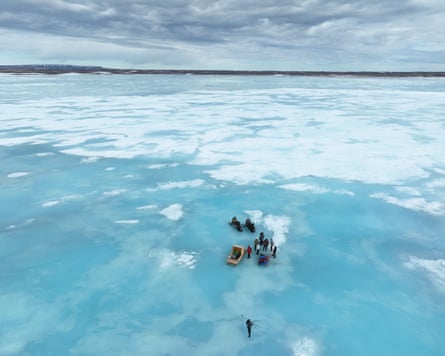
-
The treated area is apparent as a white island in the blue meltwater. Photograph: Cìan Sherwin/Damian Carrington
Ice reflects 70% of the sun’s heat back into space, while open ocean reflects just 7%. The more that melting exposes the sea, the warmer it gets and the more melting there is. Summer sea ice could be gone as early as the 2030s and scientists worry that the heat boost could push the climate beyond catastrophic and irreversible tipping points.
On the ice, the team are busy measuring everything they can: temperature every 2cm down through the ice, long cores for salinity, ice structure and biological analysis and, crucially, how reflective is the area they have re-iced. A drone buzzes through its daily circuit overhead, recording the area down to 5cm resolution.
Despite the blue sky and strong sun, it’s still chilly on the ice thanks to the wind. But winter was a whole different level of cold. “The coldest day was -63C with wind chill,” says Simon Woods, Real Ice’s cofounder with Cían Sherwin. The extreme temperatures kept the team off the ice then, but they worked in temperatures of -40C, keeping a keen eye on each other for signs of frostbite.
Ceccolini says: “In a whiteout, without the Inuit guides we would not know how to get home – you can’t see anything 10m in front of you.” Wildlife is another hazard, from the possibility of polar bears to arctic foxes chewing through the cables of the equipment.
In January and February, the pumps ran for a total of 1,080 hours, icing over a square area about 450 metres on a side. The small pumps require less power than a toaster as they are only lifting the water from just under the ice to just on top.
The results can now be seen from space, with the team members excited to view the latest satellite images in their morning meeting. They show the test area emerging as an island of white in a sea of blue a few days after the melt season began.
The ice-thickening process gets a boost because the pumped seawater turns the highly insulating snow layer on top into slush and then ice. This means the extreme cold of the air penetrates through the ice better, stimulating extra ice growth on the bottom.
The team now pump later in the winter, so a new snow layer has less time to build up, and they have also found that doing two separate rounds of pumping improves results.
Last year, Real Ice added about 30cm, and this year’s extra thickness is 50cm, Ceccolini says. That may not sound huge, but a pickup truck can drive over 30cm of ice, and it may add 7-10 days to the lifespan of the ice, he says.
There’s also been a bonus: the ice created by the team is brighter and more reflective than the surrounding natural ice. “That was totally unexpected,” Ceccolini says. A possible explanation is that the fast-frozen artificial ice traps more air bubbles, which make the ice more opaque than the gradually frozen natural ice.
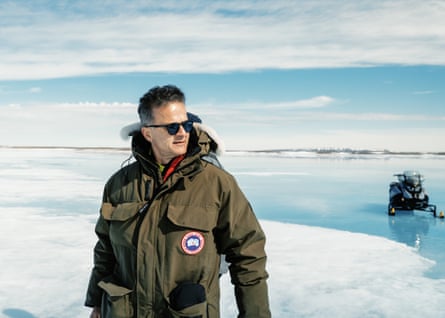
-
Andrea Ceccolini is the chief executive of Real Ice. Photograph: Brodie Larocque/The Guardian
Sea ice experts from the University of Washington are working independently at the site to determine the answer. Prof Roger Marchand and Melinda Webster spend hours every day on the ice to measure precisely how reflective the ice is, and how salty. The latter is important as salty ice will melt at a lower temperature.
Webster, a polar scientist who has worked in the Arctic every year since 2009, says global heating has radically changed the landscape over that time. “It looks so different because the ice has been thinning over the decades.”
Sherwin, who cofounded Real Ice with Woods, is watching a gleaming whirlpool where water is rushing into a hole in the ice. It’s a test of another tool to fight the melting of the Arctic. A couple of years ago, the team noticed a few such holes formed naturally, so they decided to drill test holes themselves.
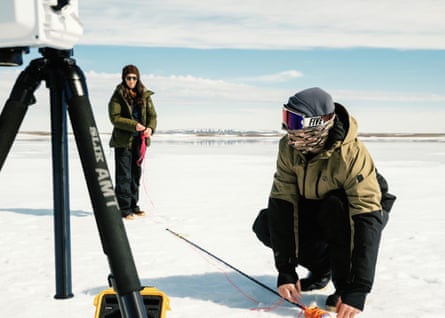
-
The researchers Cìan Sherwin, a cofounder of Real Ice, and Melinda Webster taking measurements. Photograph: Brodie Larocque/The Guardian
The day before, Sherwin drove a long silver drill bit into the ice, its whirring leaving half a dozen holes, each 5cm wide. It was like pulling the plug out of a bath. Within a few minutes, water was swirling down the hole.
But that was just the start: the ice holes rapidly widen themselves, most likely due to the warmth of the meltwater. “It’ll be the size of a dinner plate in 45 minutes,” Sherwin said. A day later, the holes are the size of maintenance hole covers – and a new hazard for the researchers.
By draining the melt pools, the bright ice underneath is exposed once again, boosting reflection of the sun’s heat. The aerial drone images show the six test holes drilled have visibly brightened the area. The experiment is in its early stages but Ceccolini says: “Perhaps that will give the ice an extra week.”
‘Everybody uses the ice’
“The ice is very important to us,” says Kyle Weese, one of the Inuit guides working with Real Ice. About 83% of the population of Cambridge Bay are Inuit. “Everybody uses the ice for transport, gathering food, fishing. You use it to get across to the mainland and do some good caribou or moose hunting. It’s very plentiful there.”
Weese, 34, has seen climate change up close. “The ice is thinner. The freeze-up takes longer than normal and the thaw happens faster now. It’s definitely changing.” The warming is also bringing new risks from the south: “Grizzly bears are coming around too.” His rifle is close at hand.
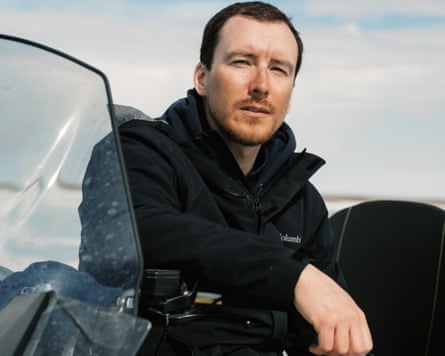
-
Kyle Weese: ‘The ice is very important to us.’ Photograph: Brodie Larocque/The Guardian
Weese is happy to work with Real Ice: “At first, the idea does sound crazy but it is not trying to hurt the environment, it’s actually trying to help it. It’s good to know how it’s changing so we can try to adapt with it and try to preserve it.”
Real Ice, which has a £3.5m grant from the UK’s Advanced Research and Invention Agency (Aria) as part of the agency’s rethickening Arctic sea ice programme, consulted with the community and was given approval for the research from local authorities and, importantly, the Ekaluktutiak Hunters and Trappers Organization.
“The biggest thing is that we learn from the Inuit,” says Sherwin, including in determining the exact location of the test site – away from hunting areas – how to travel on the ice and where best to make the holes.
There’s no sign of opposition to the project in Cambridge Bay, with one local official telling the Guardian: “Their local engagement is the best I have seen – it’s been community-first from the beginning.”
Underwater drones
The big question is: if further research can show this experiment is effective and safe in restoring sea ice, could it be done at scale? Using teams of people on the ice to do this would be unfeasibly expensive, but an alternative is being tested: autonomous underwater drones.
A prototype undertook trials this February in Finland’s Gulf of Bothnia, poking holes in the sea ice using an electrically heated probe. It is now being refined in collaboration with the BioRobotics Institute in Pisa, Italy. Doing everything from under the ice, perhaps counterintuitively, is far easier than trying to navigate across ice fields in extreme cold, says Ceccolini.
Below the sea surface, the temperature is a constant -1.6C. “Everything works comfortably: electronics, batteries, pumps – you just stick your nose out of the ice, pump water and go back in,” he says. The vision is of a swarm of hydrogen-powered underwater drones targeting key areas at the leading edge of ice loss.
The area of summer sea ice that has vanished since 1979 is about 3m square kilometres – about the size of India. A further 80,000km2 is lost every year on average – the area of Scotland or Kansas.
“So that’s a possible start,” says Ceccolini. “Even if you have just 20cm of ice, you still reflect the sun.” And at a much more local level, sea ice rethickening could make the routes relied on by Inuit people safer.
If the underwater drones cost about $5,000 each, Real Ice’s rough estimate is that bringing the annual shrinking of Arctic sea ice to a halt would cost $10bn over the longer term. For comparison, that is the same as the windfall profits made by the top 100 oil companies in less than a fortnight after the Iran war sent the oil price soaring. If only drilling drainage holes is effective, that would be substantially cheaper as no pumping is needed.
Marchand, from the University of Washington in Seattle, says: “Whether you can do this on a scale that’s large enough to be climatically important is a difficult and open question.
“But I feel like Real Ice are doing the right things. They’re trying to understand the physics of what’s going on and then using that knowledge to answer the question, rather than just assuming that this is doable. They’re going step by step.”
Environmentally dangerous?
Geoengineering is controversial, and a significant number of polar scientists are opposed to the idea of sea ice thickening: they published a critique in September arguing that it was unfeasible, would be “environmentally dangerous” and posed a dangerous distraction to the core climate need to cut carbon emissions rapidly.
Prof Shaun Fitzgerald, the director of the Centre for Climate Repair at the University of Cambridge, who is regularly on the ice with the team, agrees that emissions reduction is “critically necessary” but thinks it is important to understand additional options.
“Anything new has the potential for unintended consequences,” he says. “I liken it to clinical trials: new drugs have the potential to really help people, but we have to go incredibly carefully and understand what the risks are.”
Fitzgerald is concerned about the potential for moral hazard, that geoengineering could be seen as a magic bullet and lessen the drive for emissions cuts, though he argues there is little evidence for that to date. “I think doing research is the right thing to do. But I do respect those who have a different viewpoint.”
Ceccolini says: “We are here to resolve the research questions. Is ice thickening effective, does it have side-effects and can it be scaled economically? Then there are bigger questions, like: are governments, policymakers, communities interested? Is a society open to this type of solution?”
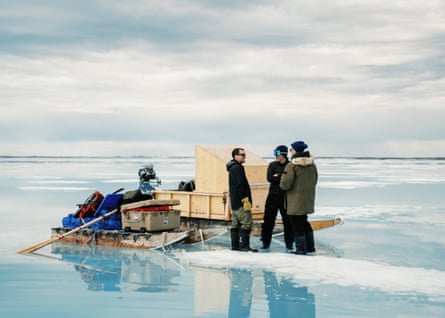
-
Researchers discuss the conditions of the research site. Photograph: Brodie Larocque/The Guardian
One outstanding question is what effect pumping seawater on to the ice has on ecology. On the ice, signs of wildlife sit in little wells of water: scraps of seaweed, fox scat, goose droppings. Their dark colour soaks up the sun and melts them into the ice.
Natural sea ice tastes fresh because virtually all the salt is squeezed out as the water molecules form ice crystals. Pumping seawater on to ice brings the salt up, as well as nutrients and microbes. Samples are now being examined by a biologist at the University of Cambridge.
Another possible concern is that drowning the winter snow with seawater could prevent polar bears and seals from digging dens for their cubs and pups, though none use the Cambridge Bay site to reproduce.
“It’s all research that has to be done and will be done as we go forward,” says Sherwin, who trained as a zoologist and was obsessed with wildlife from early in his childhood in County Cavan in the Republic of Ireland.
When Woods and Sherwin founded the project, the first thing they did was go up to the Arctic. “We went up to Iqaluit [the capital of Nunavut in Canada] and simply asked key stakeholders the question: ‘Is this interesting or valuable to your community?’,” says Woods. “We got an overwhelmingly positive answer and thought, OK, let’s try to do this.” Real Ice, which is in effect a non-profit company, was formed in 2022.
It is not the only group trying to refreeze the Arctic. This year Arctic Reflections, also funded by Aria, produced a similar-sized patch to Real Ice, which preliminary results indicate was up to 45cm thicker. However, these researchers are pursuing a different strategy, aiming to strengthen “ice arches” that span narrow straits and could hold back sea ice from flowing south and melting, and it is still too early to tell if the idea can work.
Back on the ice, Sherwin is taking the latest set of measurements. His view of the future is straightforward: “We’d like to see the research just continue to go forward in a way that we can have an informed opinion on what this looks like at scale, if it scales at all.”
Ceccolini says: “The dream is that sea ice thickening will be undertaken by the Indigenous communities. Imagine what they are going through, with the risk of losing their culture, losing their youth, people just moving away.
“They could do something that can help preserve their culture, basically doing conservation, because this is what we are talking about. This is an ecosystem conservation project.”















 English (US) ·
  French (CA) ·