

 1 day ago
4
PROTECT YOUR DNA WITH QUANTUM TECHNOLOGY
Orgo-Life the new way to the future Advertising by AdpathwayPhoto: Fermin Fernandez-Ibanez.
Severe losses. A ROP spike. Maybe even a bit drop. You are drilling a carbonate reservoir, and you just hit a cave. But is it just one isolated cavern or are there many other neighbouring ones?
Karst processes occur across a wide range of scales in carbonate reservoirs, from dissolution-enhanced pores and vugs to meter-scale caverns. It is these larger, discrete features that interest us here. They can add significant pore volume and have a major influence on reservoir performance. Yet they are difficult to characterise because a well provides only a very narrow sampling window into the reservoir. But seeing one cave raises a far more interesting question: How significant is that single intersection?
Let’s consider coastal karst developed along the margins of isolated carbonate platforms, and caverns that develop within a freshwater lens, without requiring faults or fractures to guide their location. They commonly occur as broad, sub-horizontal, flattened bodies. So, imagine drilling a well and intersecting just one cavern. It is tempting to say that you got lucky and that one cave does not mean there are many more. But did you really get lucky? If you are in an area where your geologic concepts indicate a high probability of karst, chances are there are more.
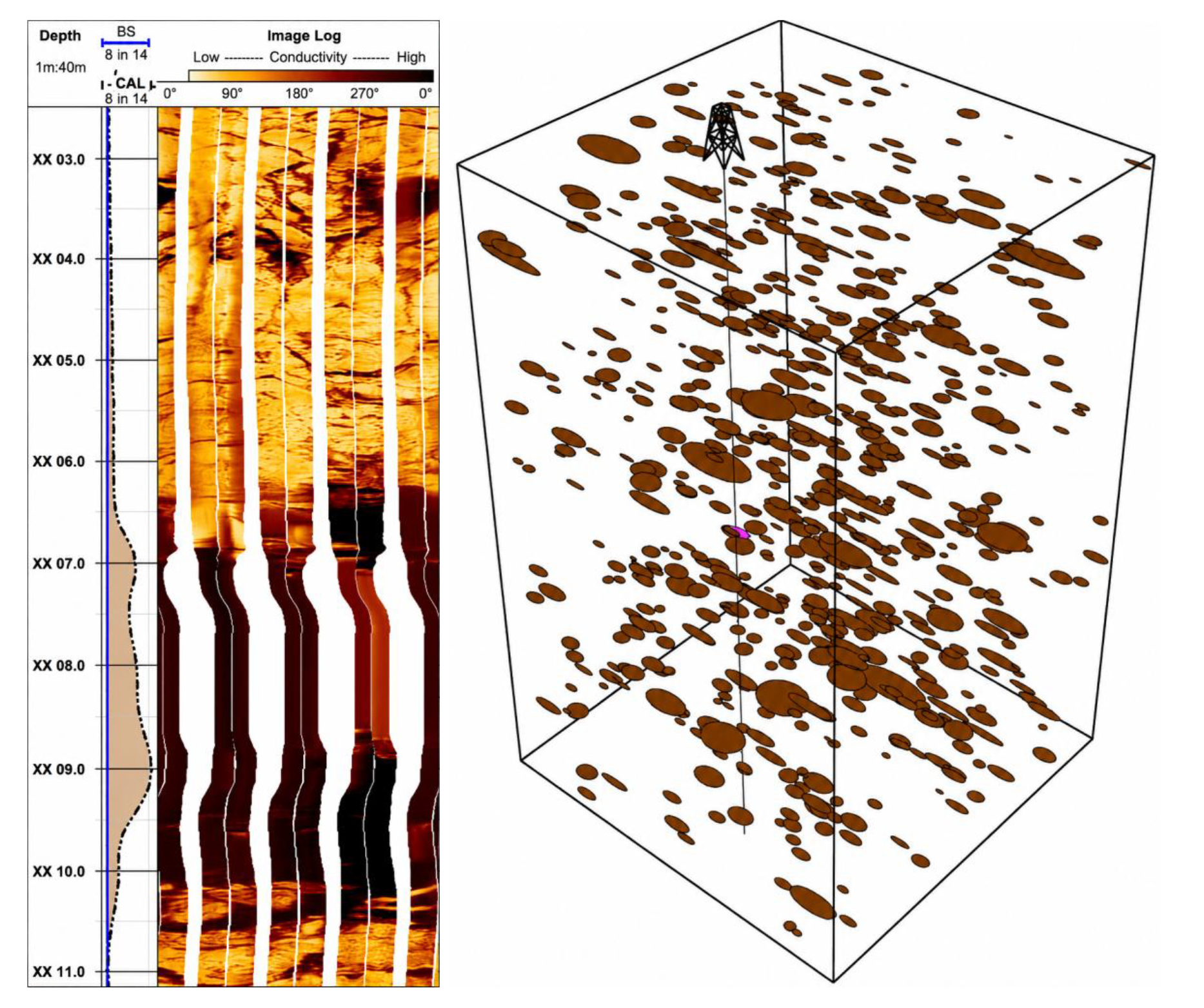 Left: Example of a cave observed on a resistivity image log. Note the caliper enlargement and high conductivity associated with the feature, consistent with open pore space. Right: Example of a Monte Carlo realisation in which caves were randomly distributed within a given volume. This realisation contains 705 caves, yet the well path intersects only one (magenta). Modified after Fernandez-Ibanez et al. (2019), Search and Discovery Article #42424.
To test the idea, we built a model in which caverns were represented as discrete elements with dimensions similar to modern water table caves (the majority within the sub-seismic realm) and ran a Monte Carlo simulation. Caverns were distributed stochastically within a 256 × 256 × 400 m reservoir volume (roughly equivalent to 16-acre well spacing), and we focused on realisations in which the well intersected one and only one cavern. The question was simple: how many other caverns could we place around the well while intersecting only one? After 40 realisations, we found that a single cave intersection was consistent with somewhere between 670 and 768 caverns “hiding” in that reservoir volume.
One intersection, therefore, does not necessarily mean one isolated cave. It may be the only cavern the well happened to sample from a population of hundreds. And more importantly, the volumetric implications of the “missing caverns” can be significant. For the scenario tested and assuming caverns are 100 % open, that single intersection could imply an uplift in the in-place volumes of up to 14 %, with the greatest impact in low-matrix-porosity reservoirs.
On the other hand, we also observed that some realisations contained as many as 500 caverns without the well intersecting a single one. In a karst-prone setting, not hitting a cave does not mean the caves are not there. This makes the geological concept and data that sample beyond the borehole (such as well tests) critical to understanding what the well may have missed.
Hit one cave, and there may be hundreds more. Hit none, and they may still be there. This small change in perspective, when supported by a sound geologic concept, can be a wake-up call that your in-place volumes may be missing more than you think.














 English (US) ·
 French (CA) ·